
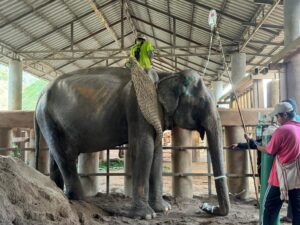
This difficulty should not be interpreted as evidence that allowing her to lie down had been a mistake. Rest remains important for animals, especially those dealing with age and physical exhaustion. The challenge was simply that Somboon required additional support because her body no longer had the strength of a younger elephant. Sanctuary staff monitored her closely and provided assistance when necessary. Similar support is sometimes required for other elderly elephants living at Elephant Nature Park.
Pets & Animals
Somboon’s diet also became an important part of her care. Missing teeth can make feeding more difficult for elderly elephants because they may not be able to chew the same foods as younger animals. Caregivers must take age, dental condition and digestive needs into account when providing meals. Save Elephant Foundation describes nutrition and medical care as central parts of its elephant program. In Somboon’s case, reports noted that the sanctuary provided nutritious food while monitoring her strength and general health.
Over the weeks following her arrival, the updates became increasingly encouraging. Somboon began moving around her surroundings and was seen walking more steadily. Images and videos also showed her enjoying mud and spending time near the river. These behaviors were positive not because they proved that every health problem had disappeared, but because they showed an elderly animal engaging with her environment after a major transition. Her advanced age meant that she would continue needing care regardless of improvements.
Two months after her rescue, a video update described improvements in Somboon’s condition and showed the relationship she had developed with people caring for her. The update emphasized the gradual nature of the process rather than suggesting an instant recovery. For an elephant in her late 80s, rehabilitation is not about returning to youthful physical condition. It is about maintaining comfort, supporting mobility and providing a safe environment where the animal no longer needs to perform demanding labor.
Somboon’s case also brought renewed attention to the lives of captive Asian elephants used in tourism. Thailand has a long and complex relationship with elephants, which have played roles in culture, labor and tourism for generations. Changes in the logging industry pushed many captive elephants and their handlers toward tourism-related work. Activities historically offered to visitors have included rides, performances and opportunities for close physical interaction.
Wildlife
Debates about elephant tourism have changed substantially in recent years. Animal-welfare organizations increasingly encourage travelers to consider how animals are managed rather than assuming that every venue calling itself a sanctuary follows the same standards. Practices involving repeated riding, forced performances or long periods of restraint have faced growing criticism from welfare groups. Some facilities have responded by moving toward observation-based experiences in which elephants are allowed more control over their activities.
Save Elephant Foundation states that its approach centers on rescue, rehabilitation, natural behavior and long-term sanctuary care. Its work includes animals that previously lived in trekking camps, logging operations, street-begging situations and entertainment venues. The organization also supports local communities and educational programs, recognizing that captive elephant welfare is connected with the livelihoods of people who have traditionally worked with elephants.
That broader context matters because the history cannot fairly be described as a simple conflict between individual tourists and individual elephant owners. Economic conditions, traditions, employment opportunities, changes in forestry policy and the growth of international tourism all contributed to the system in which captive elephants were used. Visitors can influence demand through the activities they choose, but the issue also involves people whose livelihoods depend on the animals and who may have limited economic alternatives.
Somboon’s story illustrates what can happen when an elderly working elephant moves from that system into long-term sanctuary care. At Elephant Nature Park, her value no longer depended on giving rides, participating in performances or generating income through physical labor. Her daily routine became centered around basic needs such as food, water, movement, rest and veterinary attention. For an animal of her age, those ordinary elements represented a major change.
Aging & Geriatrics
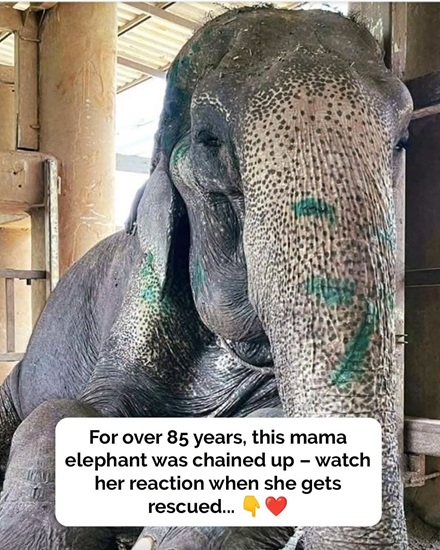
One of the most striking things about Somboon’s rescue was how little dramatic action was required for the story to affect people emotionally. The image that traveled around the world was not of her performing a remarkable trick or making a spectacular recovery. It was simply an old elephant sleeping. The significance came from understanding what had happened before that moment.
For decades, Somboon’s movements had largely been organized around human activities. After her transfer, caregivers were attempting to create an environment in which she could make more choices for herself. That might mean deciding when to walk, when to eat, when to enter mud or water, and when to rest. Choice is a basic component of animal welfare because it allows an animal greater control over its surroundings.
The concept of retirement for an elephant is obviously different from retirement for a person, but the comparison helps explain what changed. Somboon no longer had a work schedule. She did not need to carry visitors. She was not expected to move heavy material. She could spend her remaining years receiving care appropriate to her age.
Because she was so old when she arrived, caregivers also had to accept that some medical problems could not simply be reversed. Missing teeth do not grow back. Age-related joint weakness can remain. Changes in vision or skin condition may require continued management. The objective was therefore not to transform Somboon into a perfectly healthy young elephant but to improve her comfort and quality of life.
Health
