
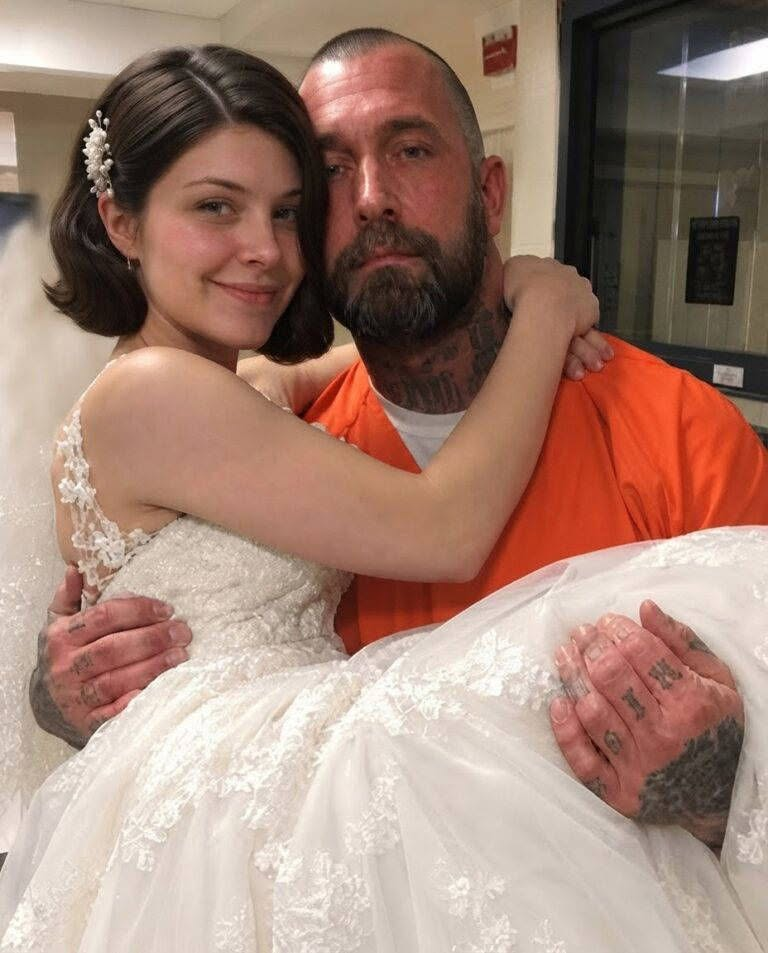
After all, we were strangers bound by an arrangement neither of us had created for love.
But Julian surprised me.
During our visits, he asked about my brother.
He remembered details I’d mentioned weeks earlier.
He wanted to know whether Toby was doing well in school and whether I’d managed to repair our unreliable old car.
Sometimes he made me laugh.
Other times, he simply listened.
His letters were even more thoughtful.
He filled the margins with tiny sketches.
Sometimes he’d draw a lighthouse.
Sometimes a house beside a lake.
Once, he drew a little birthday cake for Toby and asked me to tell him that someone was cheering for him.
Gradually, I began looking forward to our visits.
I stopped checking the clock.
Stopped rehearsing polite conversations.
And started sharing things I hadn’t told anyone else.
Then one evening, I asked Julian about the charges against him.
He grew quiet.
“I didn’t take that money, Nora.”
I studied him.
“Then why were you convicted?”
“Because the evidence made it look as though I did.”
Something in his voice stayed with me.
That night, I began reading the documents from his case.
At first, I barely understood the financial terminology.
But I kept going.
I noticed dates that didn’t align.
Documents with missing signatures.
Transactions that appeared inconsistent with the prosecution’s explanation.
And a witness who had left the state shortly after testifying.
I started asking questions.
I contacted attorneys.
Requested available records.
Spent evenings examining financial documents instead of sleeping.
I was twenty-seven, struggling to pay rent while raising my younger brother, when a wealthy woman offered me $2,000 a month to marry her son.
There was only one problem.
Her son was serving time in federal prison.
“You don’t have to love him,” she explained. “Visit him twice a month, write him letters, and help convince the court he still has a supportive family.”
I was desperate for money.
So I agreed.
Our wedding took place inside a prison visiting room, separated from the outside world by locked doors and security guards.
I expected Julian to be bitter, unfriendly, perhaps even angry.
Instead, he was gentle.
He remembered my brother’s birthday, asked whether I was eating properly, and sent me thoughtful letters decorated with little drawings.
At first, I pretended to care about him.
Then something unexpected happened.
I fell in love with the man I’d been paid to marry.
For three years, I fought to prove his innocence.
And when the truth finally emerged, Julian was released.
I thought our nightmare was over.
But eight days after he came home, he placed a mysterious black box on our kitchen table.
“What’s that?” I asked.
Julian looked at me with an expression I’d never seen before.
“Nora, there’s something you need to know. Our marriage was never as simple as my mother made you believe.”
Then he opened the box.
And everything I thought I knew about my husband began to unravel.
My name is Nora, and three years earlier, my life had been falling apart.
I was twenty-seven, working exhausting hours and barely managing to keep a roof over our heads.
My younger brother, Toby, depended on me.
After everything our family had been through, I was determined to give him a stable childhood.
But determination didn’t pay the bills.
There were overdue notices on the kitchen counter.
Our refrigerator was frequently half-empty.
And every month, I wondered whether we’d be able to afford the rent.
Then Eleanor Vance entered my life.
She was wealthy, elegantly dressed, and accustomed to getting exactly what she wanted.
Her son, Julian, had been convicted in a financial scandal involving the family’s charitable foundation.
Eleanor claimed he had become isolated and desperately needed someone to support him.
She offered me an unusual arrangement.
Marry Julian legally.
Visit him twice a month.
Write encouraging letters.
Attend important hearings when necessary.
In exchange, she’d pay me $2,000 every month.
I remember staring at her across the table.
“You’re asking me to marry a complete stranger?”
“On paper,” she answered. “It’s a straightforward arrangement, Nora. You help my son, and I make sure your family is taken care of.”
I thought about Toby.
The rent hanging over our heads.
The bills I could barely keep up with.
And the choice I had no idea I would one day regret—or be grateful for.
Then I agreed.
Our wedding was nothing like the one I’d once imagined.
There were no flowers.
No elegant reception.
No family gathered to celebrate.
Just a cold room inside a correctional facility, an official waiting to sign the papers, and a guard keeping an eye on every passing minute.
And standing across from me was Julian, wearing a prison uniform.
His gray eyes looked exhausted, but there was something strangely calm about him.
When the ceremony was over, he looked directly at me.
“I’m sorry this isn’t the wedding you deserved.”
For a moment, I couldn’t find the words.
Then he gave me a small, almost apologetic smile.
“Thank you for coming.”
I had expected our arrangement to be painfully uncomfortable.
After all, we were two complete strangers brought together by a deal neither of us had entered out of love.
But Julian began doing things I hadn’t expected.
During our visits, he never seemed interested in talking about himself. Instead, he kept asking about my younger brother.
He remembered little details I’d mentioned weeks before, things I hadn’t even realized he’d paid attention to.
He wanted to know how Toby was doing at school, whether he’d been happy with his birthday, and whether I’d finally managed to get our unreliable old car repaired.
Sometimes, he said something that made me laugh when I least expected it.
Other times, he simply sat there and listened, as though nothing I said was too insignificant to matter.
But it was his letters that surprised me most.
He filled their empty margins with tiny, carefully drawn pictures.
A lighthouse on one page.
A little house beside a lake on another.
And once, he even drew a birthday cake for Toby, adding a small message asking me to tell him that someone out there was rooting for him.
I couldn’t explain why those little gestures affected me so much.
But slowly, something began to change.
I found myself counting the days until our next visit.
And for the first time, I started wondering whether there was something about Julian that his own mother hadn’t told me.
I stopped checking the clock.
Stopped rehearsing polite conversations.
And started sharing things I hadn’t told anyone else.
Then one evening, I asked Julian about the charges against him.
He grew quiet.
“I didn’t take that money, Nora.”
I studied him.
“Then why were you convicted?”
“Because the evidence made it look as though I did.”
Something in his voice stayed with me.
That night, I began reading the documents from his case.
At first, I barely understood the financial terminology.
But I kept going.
I noticed dates that didn’t align.
Documents with missing signatures.
Transactions that appeared inconsistent with the prosecution’s explanation.
And a witness who had left the state shortly after testifying.
I started asking questions.
I contacted attorneys.
Requested available records.
Spent evenings examining financial documents instead of sleeping.
When professionals told me the case was closed, I asked whether anyone had reviewed the irregularities I’d found.
Some dismissed me.
Others agreed to take another look.
I used money I’d saved to help pay for investigative work.
It was exhausting.
But by then, I wasn’t simply fulfilling Eleanor’s arrangement.
I believed Julian.
More importantly, I loved him.
Three years after our prison wedding, new evidence finally exposed what had happened.
Julian’s cousin had diverted funds from the family charity and used forged documents to make Julian appear responsible.
The case was reopened.
The evidence was examined.
And eventually, Julian’s conviction was overturned.
The day he walked out of prison, I waited outside with tears in my eyes.
I expected him to rush into my arms.
Instead, he stopped a few steps away.
For a moment, his expression was difficult to read.
Then he reached for my hand.
“Come home with me, Nora.”
I held him tightly.
I believed we’d survived the worst years of our lives.
For one wonderful week, we lived like an ordinary married couple.
We cooked dinner together.
Watched movies.
