
Eleanor took a sharp breath.
“Stay away from those documents.”
“Why?”
“Because he doesn’t understand what he’s dealing with. Those records involve powerful people, Nora. People who will do anything to protect themselves.”
I looked at Julian.
He stood motionless.
Then Eleanor said something that made my blood run cold.
“I have a car waiting outside your building. Bring the box downstairs, and I’ll transfer five million dollars to your account tonight.”
I stared at the phone.
“Five million?”
“Yes. Take your brother and leave. Start over somewhere safe.”
I thought about our old apartment.
The unpaid rent.
The nights I’d worried about feeding Toby.
Five million dollars would change everything.
But then I looked at Julian.
The man who’d written me letters.
Who’d remembered my brother’s birthday.
Who’d become my husband in every way that mattered.
He’d deceived me about important things.
And I was furious about that.
But Eleanor was now offering an enormous sum to make evidence disappear.
“Why are you so desperate to get those documents?” I asked.
“Nora, don’t be foolish.”
“Did you know Julian was innocent?”
Silence.
“Did you know someone had framed your son?”
“Nora—”
“Answer me.”
Her voice became cold.
“You have no idea what sacrifices are necessary to protect a family.”
I closed my eyes.
That was answer enough for me.
I picked up the steel key.
“You paid me because you thought I was desperate enough to do whatever you wanted.”
“Take the money, Nora.”
“No.”
Eleanor fell silent.
“I married your son for two thousand dollars a month,” I continued. “But I stayed because I loved him.”
Then I looked at Julian.
“And whatever happens next, nobody gets to make another decision for me without telling me the truth.”
I ended the call.
Julian exhaled slowly.
“You refused five million dollars.”
I looked at him.
“Don’t mistake that for forgiving everything you’ve hidden.”
He nodded.
“I won’t.”
Then he glanced toward the apartment door.
“We need to act carefully. My mother wasn’t bluffing about the people involved.”
I folded my arms.
“Then no more secrets. If I’m your partner, I need to understand exactly what we’re doing.”
Julian looked at me for a long moment.
Then he turned his laptop toward me.
“I’ve already arranged for an attorney to review the evidence and coordinate with the appropriate authorities.”
On the screen was a secure file-transfer portal.
Several documents had been prepared for submission.
Julian explained that the financial records could implicate company executives and people connected to the family foundation.
Some information still needed independent verification.
Other records were already supported by banking documents and correspondence.
“These files could trigger a much wider investigation,” he said.
I stared at the screen.
“Then we need to make sure the right people receive them.”
He nodded.
We reviewed the prepared submission together.
Then, with our attorney’s guidance already in place, we authorized the transfer of the relevant records.
Neither of us knew exactly what would happen next.
But for the first time, the family’s secrets were no longer entirely under Eleanor’s control.
The following months were difficult.
Investigators examined the financial records.
Former employees were interviewed.
Additional documents were obtained through legal proceedings.
The case expanded far beyond Julian’s original conviction.
Eventually, evidence linked Eleanor and other family associates to a complicated network of fraudulent transactions.
Julian’s cousin cooperated with investigators.
The family foundation’s activities were scrutinized.
And the financial empire that had once seemed untouchable began to unravel.
Eleanor eventually faced criminal charges and later pleaded guilty to several offenses.
The consequences extended across the family’s businesses.
Assets were frozen.
Improperly obtained funds were identified.
Restitution claims were pursued.
And the trust became the subject of extensive legal proceedings.
The original three-billion-dollar valuation no longer represented what Julian and I might actually receive.
After the disputed holdings, liabilities, and compensation obligations were addressed, substantial legitimate assets remained under the trust’s administration.
It was still more money than I had ever imagined.
But the money wasn’t what mattered most to me.
For years, I’d measured my life by overdue bills and how many hours I needed to work to keep Toby safe.
Now, for the first time, I had the freedom to decide what kind of future I wanted.
One year later, I stood on the porch of a quiet house overlooking a lake in upstate New York.
Autumn leaves covered the lawn.
The air smelled of pine trees and fresh coffee.
Across the grass, Toby was throwing a football with two friends from college.
He was nineteen now.
Healthy.
Confident.
And enjoying the opportunities I’d once worried I couldn’t provide.
Julian stepped onto the porch wearing jeans and a simple navy sweater.
He wrapped his arms gently around me.
“Toby’s getting better at that throw.”
I smiled.
“He practices every morning.”
We watched my brother laugh as one of his friends missed the ball.
Then Julian asked, “Do you ever think about the visiting room?”
I turned toward him.
“Sometimes.”
He nodded.
“So do I.”
We stood quietly for a moment.
Over the previous year, we’d worked through difficult conversations about trust, honesty, and the choices Julian had made.
His intentions hadn’t erased the hurt he’d caused.
But he’d stopped making decisions on my behalf.
And slowly, we’d begun rebuilding our marriage on something more honest than the arrangement that brought us together.
We’d also established a charitable initiative to support legal assistance and independent case reviews for people who lacked the resources to challenge questionable convictions.
It felt like the most meaningful use of what we’d been given.
Julian brushed a strand of hair away from my face.
“Three years ago, I thought I’d lost everything.”
I smiled faintly.
“And I thought I was marrying a stranger for rent money.”
He laughed softly.
“Neither of us understood what we were getting into.”
“No,” I agreed. “We certainly didn’t.”
Then he reached into his pocket.
When I saw the small velvet box, I raised an eyebrow.
“Julian, please tell me you’re not bringing another mysterious box into my life.”
He laughed.
“No secrets this time.”
He opened it.
Inside was a simple platinum ring with a beautiful diamond.
I stared at him.
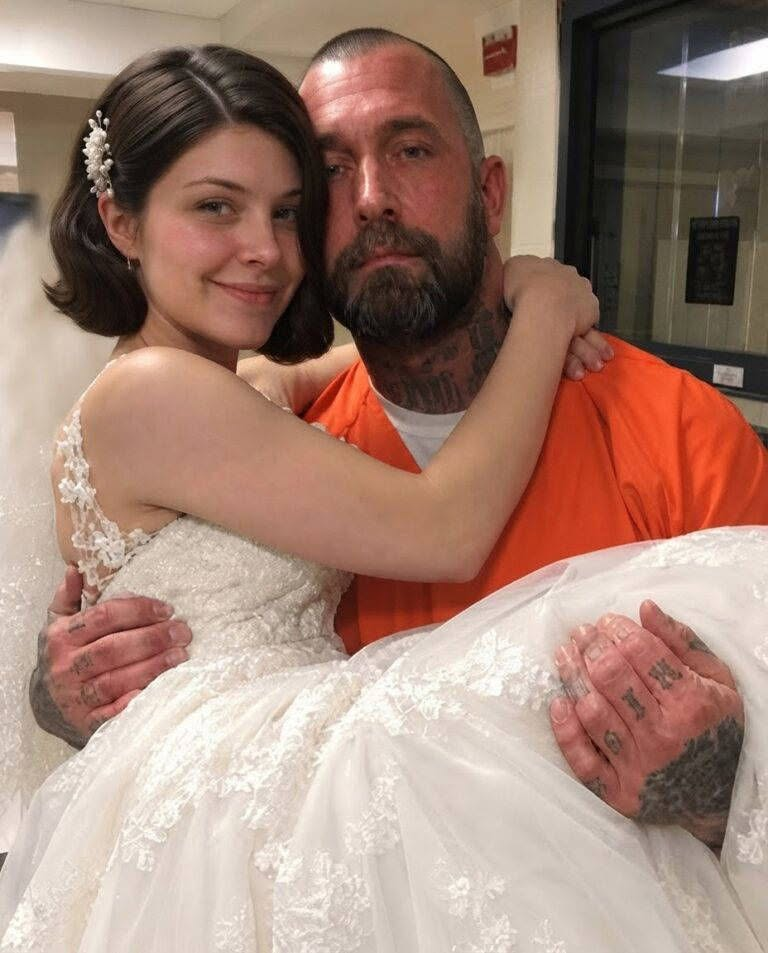
“Our first wedding happened in a prison,” he said. “You were there because someone paid you to come.”
My eyes filled with tears.
He took my hand.
“I want to ask you something now, with no arrangement, no family pressure, and no hidden plan.”
He paused.
“Nora, will you marry me again—this time because we both choose it?”
I looked at the man standing before me.
The stranger I’d once married behind locked doors.
The husband I’d fought to bring home.
The person who’d hurt me with secrets but had spent the past year working to earn back my trust.
Then I smiled.
“Yes, Julian.”
I held out my hand.
“But this time, I get to help plan the wedding.”
He laughed and slipped the ring onto my finger.
“Deal.”
Across the lawn, Toby called out to ask whether we wanted to join the game.
I looked toward him, then back at Julian.
For so long, I’d believed that happiness meant escaping hardship.
But I’d learned something more important.
A future worth having couldn’t be built on money alone.
It needed honesty.
Respect.
And the freedom to make your own choices.
I entered that prison marriage because I needed $2,000 a month to survive.
Three years later, I discovered that the most valuable thing I could ever receive wasn’t a share of a fortune—it was the chance to build a life that finally belonged to me.
