
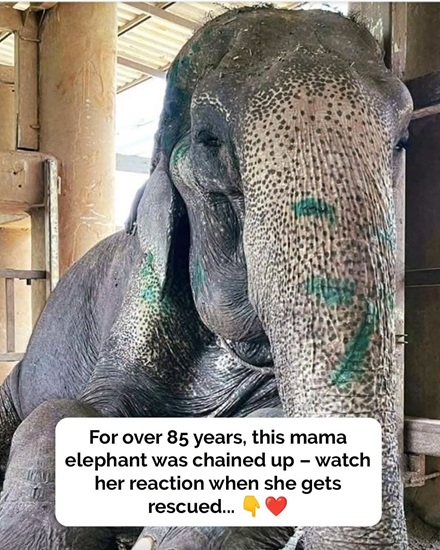
For most of her extraordinarily long life, an elderly Asian elephant named Somboon knew very little of the kind of retirement people normally associate with old age. By the time rescuers reached her in Thailand in January 2024, she was estimated to be about 87 years old and had spent decades working in industries that used captive elephants for logging, transportation and tourism. Accounts connected to her rescue describe a life shaped by long periods of labor and restricted rest.
Wildlife
Somboon eventually became known internationally after Save Elephant Foundation arranged for her transfer to Elephant Nature Park in northern Thailand. Her arrival there marked the beginning of a very different stage of life, focused on food, veterinary attention, rest and freedom from regular work. Somboon’s story attracted widespread attention partly because of her advanced age. Reports published around the time of her rescue described her as approximately 87, making her an exceptionally old Asian elephant.
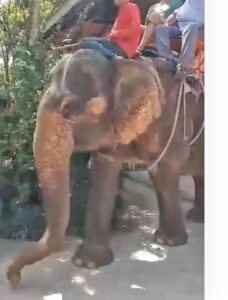
Her history was reconstructed largely through information shared by people familiar with her earlier life and by the rescue organization caring for her. Those accounts say she had spent much of her life performing physically demanding work. When she was younger, she was reportedly used in logging, a type of labor in which elephants historically moved heavy timber through difficult terrain. Later, as Thailand’s elephant economy changed, Somboon was used in tourism-related work.
Reports based on information shared by her former keeper said that Somboon had worked in several different settings during her lifetime. At different periods she was reportedly involved in carrying logs, giving rides, participating in ceremonial activities and being taken through streets where money was collected from members of the public. In later decades, tourism became a major part of her routine. One account stated that she spent more than 30 years giving rides and could work for many hours in a day. Because much of her early history occurred many decades ago, not every detail can be independently documented, so the most careful description is that these are the histories reported by people connected with her care and rescue.
Aging & Geriatrics
What was much easier to observe by the time of her rescue was Somboon’s physical condition. Photographs and updates showed an elderly elephant who was very thin and visibly affected by age. Reports described missing teeth, dry or unhealthy-looking skin and reduced physical strength. Like many elderly elephants, she also had difficulty with mobility, particularly when attempting to rise after lying down. These conditions required close monitoring after her arrival at the sanctuary. Her age alone made recovery very different from what rescuers might expect from a younger animal.
Save Elephant Foundation became involved after learning about Somboon’s circumstances. The Thai nonprofit works with captive elephants through rescue, rehabilitation and sanctuary programs and is closely associated with Elephant Nature Park near Chiang Mai. The foundation describes its mission as providing elephants in need with long-term care while also supporting rehabilitation and environments where rescued animals can live without returning to demanding work. Somboon became one of the elderly elephants brought into that system of care.
Her transfer took place at the end of January 2024. Updates shared during the rescue indicated that Somboon was leaving the location where she had worked and traveling to Elephant Nature Park, where the intention was for her to spend the remainder of her life without the responsibilities that had shaped her earlier decades. Posts documenting the journey appeared on January 29 and January 30, showing that the operation was carefully followed by the people involved. The transfer itself was significant because moving an elderly elephant requires special attention to physical stress, hydration and the animal’s ability to remain stable during transport.
Veterinarians
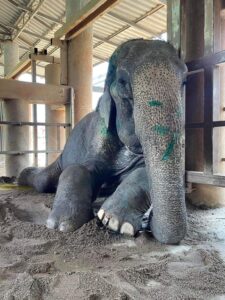
Once Somboon arrived at Elephant Nature Park, caregivers prepared an area suited to her age and physical condition. One particularly important feature was a soft sand bed. Sand is used in sanctuary settings because it can provide a gentler resting surface for elephants with weakened joints or other mobility problems. For an elderly animal, getting down and standing again can be physically demanding, so the condition of the ground matters considerably. Somboon’s response to the new resting area soon became the part of her story that received the most attention online.
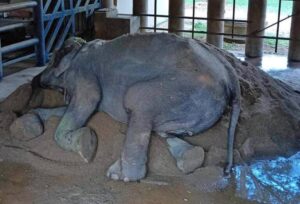
Newly rescued elephants do not always lie down immediately after entering an unfamiliar environment. Rescue organizations have explained that some remain cautious for days or weeks while becoming accustomed to new surroundings. Somboon behaved differently. According to accounts based on Save Elephant Foundation’s updates, she approached the prepared sand area and lay down soon after arriving. She then slept deeply despite activity around her. The moment was interpreted by caregivers as a sign of just how exhausted she was after her journey and advanced age.
Health
The image of Somboon sleeping became widely shared because it looked so simple. There was no complicated rescue equipment visible in the central moment and no dramatic performance. There was simply an elderly elephant resting on soft ground. Yet the context made that ordinary behavior meaningful to many viewers. After a life reportedly dominated by human-directed work, the sanctuary was allowing her to choose when to rest rather than requiring her to follow a work schedule.
It is important, however, not to exaggerate the moment into claims that cannot be proved. Some online versions of Somboon’s story have said that it was literally the first time she had lain down in 80 years. There is no reliable way to establish such an absolute claim about every night of an elephant’s life. What the rescue accounts clearly support is that Somboon had experienced years of demanding conditions and that she lay down almost immediately after reaching her prepared sand bed at Elephant Nature Park. That fact is powerful enough without adding certainty that the available evidence cannot provide.
Her long sleep created another challenge. When Somboon eventually needed to stand again, she could not easily rise on her own. Elderly elephants can struggle to stand after lying down because of weakened muscles, joint problems or poor overall condition. The sanctuary team therefore had to assist her. Later updates from Elephant Nature Park explained that Somboon was among several older elephants requiring help to get back onto their feet. Caregivers hoped that improved nutrition, regular monitoring and time would strengthen her enough to make movement easier.
