
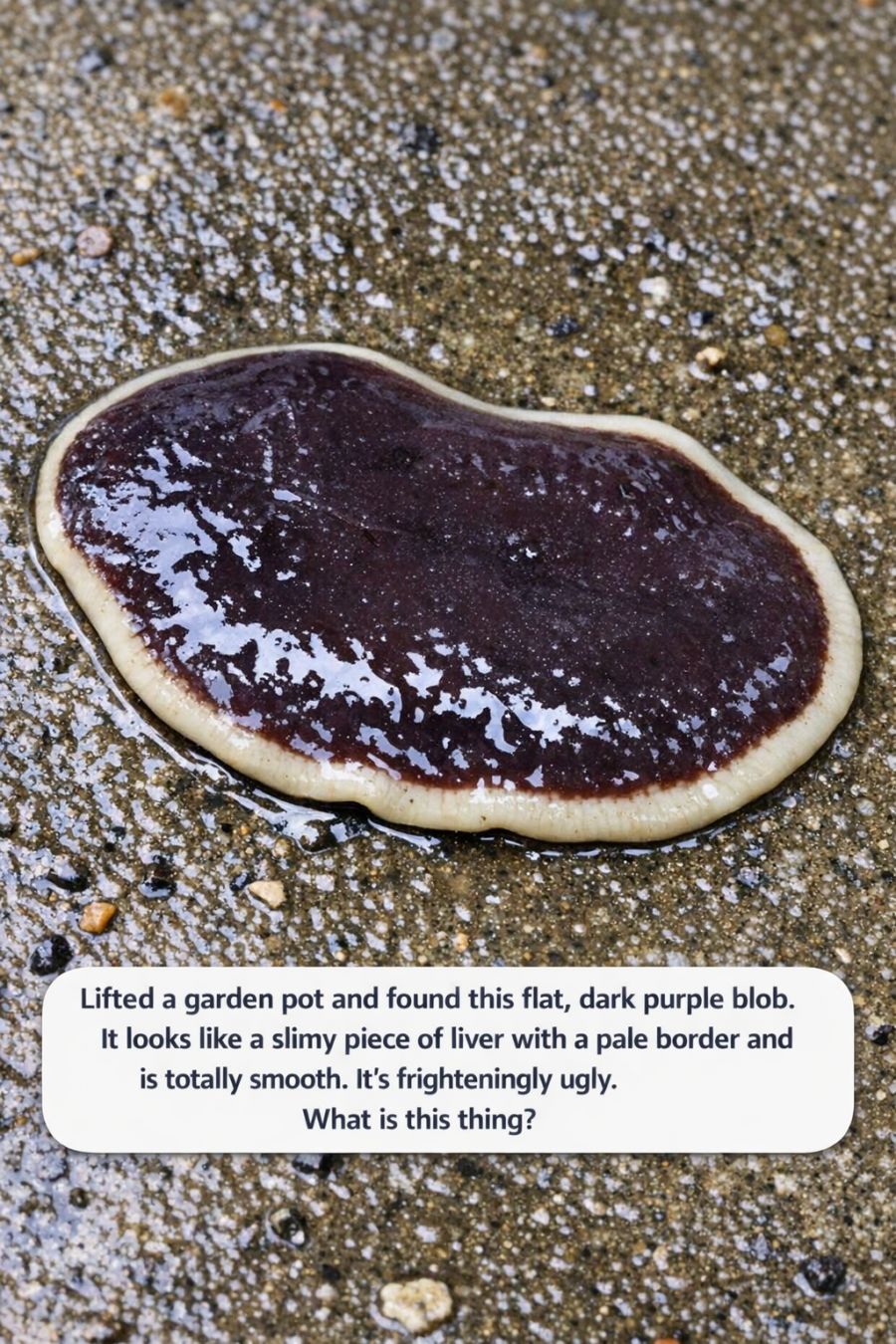
You reach down to move a garden pot, lift it up, and there it is — a strange, flat, dark purple blob clinging to the underside of the container or pressed against the soil beneath. It has a pale, slightly lighter border around its edges, the surface is completely smooth, and the whole thing looks unnervingly like a slimy piece of raw liver. You step back. You wonder whether something has gone seriously wrong in your garden. You might even wonder whether it is alive, dangerous, or a sign that something is killing your plants. Take a deep breath. What you have almost certainly stumbled across is one of the most ancient and fascinating organisms on earth — and it is not nearly as alarming as it looks.
What Is That Purple Blob? Most Likely a Liverwort
The flat, dark purple, liver-like organism you found under your garden pot is almost certainly a liverwort — specifically a thallose liverwort, which is the type that produces the flat, ribbon-like or plate-like body structure rather than tiny individual leaves. The most common species you are likely to encounter in a garden setting is Marchantia polymorpha, also known as the umbrella liverwort, or one of its close relatives such as Reboulia hemisphaerica, the purple-fringed liverwort — which is particularly known for its striking purple underside that can startle anyone who encounters it for the first time.
The name “liverwort” actually comes directly from the plant’s appearance. In the ancient Doctrine of Signatures — a system of belief used in Classical Greek and Roman medicine that held that God had marked living things with visual clues to their medicinal purposes — certain thallose liverworts were thought to resemble a human liver in shape and texture. The name stuck. The word “hepatic,” which also refers to liverworts, shares the same origin: the Greek word for liver, “hepar,” which also gives us the medical term “hepatitis” for liver inflammation. So that liver-like appearance you noticed is not a coincidence — it is literally what the plant was named after.
Understanding What You Are Looking At
Liverworts are among the most primitive land plants still in existence — living biological links between the algae that first emerged from ancient oceans and the complex vascular plants that cover the earth today. They are non-vascular plants, meaning they have no internal system of tubes to transport water and nutrients the way trees and flowering plants do. Instead, they absorb moisture directly through their entire body surface and anchor themselves to whatever substrate they are growing on using tiny, colorless, hair-like structures called rhizoids rather than true roots.
The flat, plate-like body you are looking at is called a thallus — the technical term for a plant body that has not been differentiated into distinct stems and leaves. In thallose liverworts like the ones most commonly found under garden pots, the thallus typically has a relatively flat, ribbon-like shape that forks as it grows, spreading outward in a branching pattern. The upper surface is usually green, while the underside — which is what you were looking at when you lifted the pot — is often purple, particularly in species like Reboulia hemisphaerica. The pale border you noticed around the edges is the actively growing tip of the thallus, which is typically lighter in color and may appear almost translucent or whitish compared to the darker, more mature tissue toward the center.
Why Was It Under Your Garden Pot?
This is not mysterious at all once you understand what liverworts need to survive and thrive. They are organisms of moisture, shade, and humidity — and the underside of a garden pot sitting on damp soil in a partially shaded area of a garden is essentially a perfect liverwort habitat. Garden pots create a stable, protected microenvironment that maintains consistent moisture and temperature while blocking the direct sunlight that would dry out and kill a liverwort. The dark, humid space between the pot base and the soil surface is precisely the kind of sheltered, damp niche these ancient organisms seek out.
Liverworts are also commonly found on the upper surface of potting compost in containers, on shaded stone paths and paving, on the damp soil of garden borders and raised beds, on the bark of stressed or mature trees, on the sides of terracotta pots that stay consistently wet, and along the banks of streams or garden water features. In the Pacific Northwest and other regions with cool, damp winters, liverwort growth in gardens is particularly common from early autumn through late spring. They flourish in exactly the conditions that describe a well-watered, shaded garden — which is why so many gardeners encounter them.
