
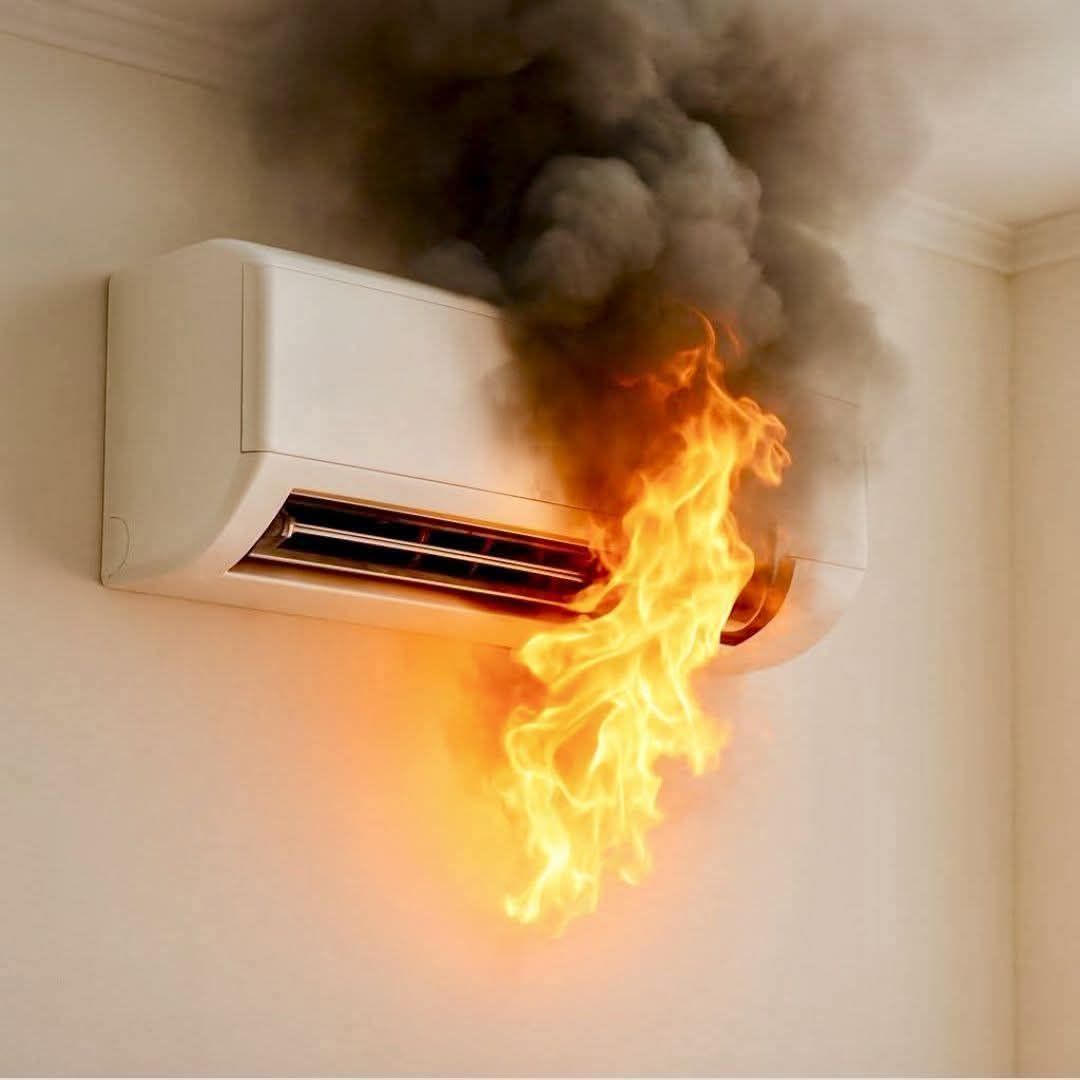
One of the most insidious and frequently overlooked fire hazards in air conditioning systems is also one of the simplest to prevent: accumulated dirt, dust, debris, and grime on critical components. Your AC system moves enormous quantities of air continuously, and over time, particles accumulate on filters, coils, condenser fins, and motor components. When these components become clogged or excessively dirty, the system has to work dramatically harder to achieve the same cooling result — and that extra strain generates heat.
Dirty condenser coils are particularly problematic. The condenser coil’s job is to release heat from the refrigerant to the outside air. When it is coated in dirt, dust, pollen, grass clippings, or other debris, it cannot release heat efficiently. The result is excessive heat buildup within the system — heat that has nowhere to go and that places enormous pressure on the compressor and other components. This buildup of pressure and temperature can eventually lead to a mechanical failure or, in severe cases, a fire or catastrophic compressor failure that sends metal fragments flying outward like shrapnel.
Additionally, when motor bearings lack adequate lubrication, the resulting friction generates intense heat. Even a small spark produced by this friction in the presence of accumulated dust and oil residue is enough to start a fire.
Warning signs to watch for: The system running constantly without adequately cooling the space, unusual heat coming from the outdoor unit, the unit shutting itself off prematurely (thermal overload protection activating), grinding or squealing noises from the motor, or visibly dirty and matted condenser fins on the outdoor unit.
Prevention: Change or clean air filters every 1 to 3 months depending on household conditions. Have the condenser coils professionally cleaned annually. Ensure the area around the outdoor unit is kept clear of vegetation, leaves, and debris. Schedule regular lubrication of motor bearings during annual maintenance visits.
Hazard #4: Damaged or Cracked Heat Exchangers
In systems that combine heating and cooling — central HVAC systems that use a furnace component — the heat exchanger is a critical piece of equipment that separates the combustion gases from the air circulating through your home. When the heat exchanger is intact and functioning correctly, combustion byproducts like carbon monoxide are safely vented outside the building. But when the heat exchanger cracks or develops damage, it can no longer maintain that separation — and the consequences are potentially life-threatening.
A cracked heat exchanger allows carbon monoxide to leak into the air circulating through your home. Carbon monoxide is a colorless, completely odorless gas that is both highly toxic and flammable. It is one of the leading causes of accidental poisoning deaths in the United States. Beyond its deadly toxicity when inhaled, carbon monoxide accumulating within the HVAC system creates a genuine fire and explosion risk. When flammable gas builds up inside an enclosed system and encounters an ignition source — an electrical spark, a pilot light, or any heat-generating component — the results can be catastrophic.
Heat exchangers crack for several reasons: normal metal fatigue from thousands of heating and cooling cycles over years of use, overheating caused by restricted airflow (often from clogged filters), improper gas pressure causing the exchanger to run excessively hot, or simple age and corrosion in older systems.
Warning signs to watch for: An unexplained headache, dizziness, nausea, or fatigue that seems to improve when you leave the house (classic carbon monoxide poisoning symptoms), a carbon monoxide detector alarm, unusual smells when the heating system runs, visible cracks or corrosion on accessible parts of the furnace, or the pilot light frequently going out.
Prevention: Install carbon monoxide detectors on every level of your home and near sleeping areas, and test them monthly. Schedule annual professional HVAC maintenance specifically including a heat exchanger inspection. Replace aging HVAC systems before their components fail — most heat exchangers have a lifespan of 15 to 25 years.
