
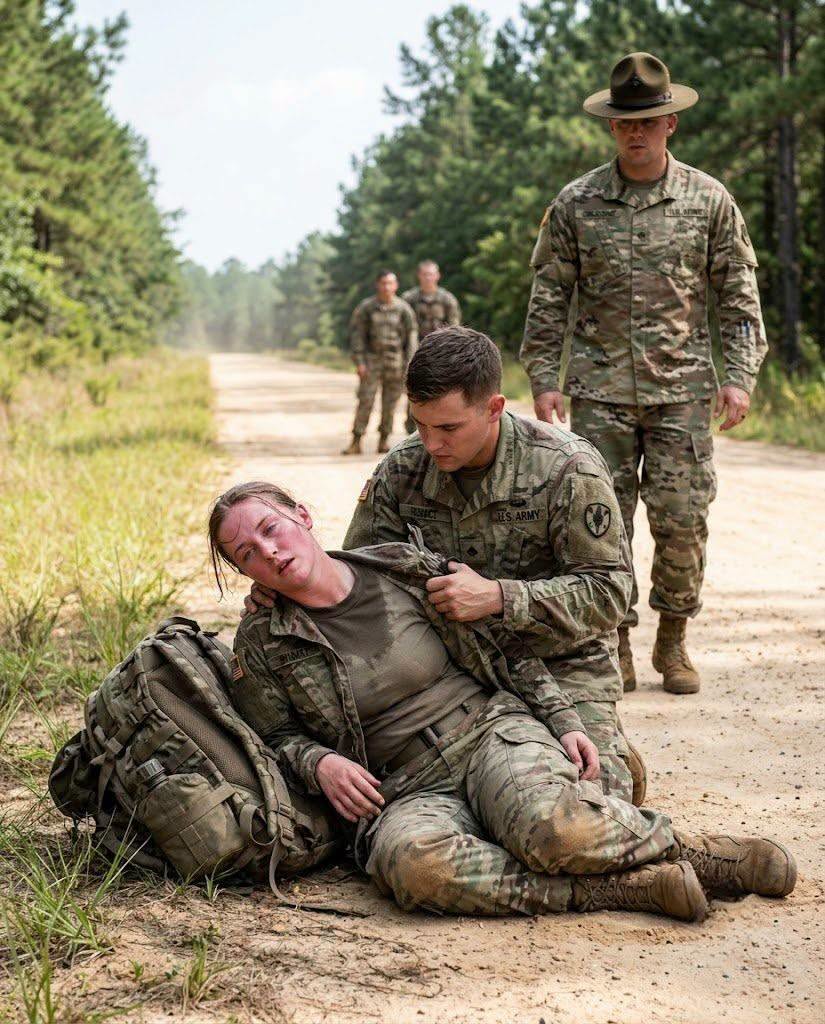
Three days before the next training cycle began, Captain Bennett called me back to her office.
A senior selection NCO sat beside her.
My stomach dropped.
Bennett pointed to the chair.
“Your temporary medical restriction ends Friday if the skin check is clean.”
“Yes, ma’am.”
“You missed a required event.”
There it was.
I nodded.
“I understand.”
“Do you?”
I looked up.
The senior NCO slid a form across the desk.
“You’re getting a supervised reattempt. Neutral cadre. Same published standard. No penalty attached to Sergeant Vega’s recommendation.”
For a second I didn’t touch the paper.
Bennett continued.
“The review determined his written assessment relied repeatedly on unsupported assumptions that were inconsistent with your recorded performance. His recommendation has been removed from your selection decision.”
I stared at her.
“Removed?”
“You will be judged on the standard, Mercer. Nothing else.”
That should have felt like victory.
Instead, fear arrived first.
Because now there was nowhere to hide.
No Vega to blame.
No argument about fairness.
Just twelve miles.
Me and the road again.
My reattempt started at 0545 the following Tuesday.
Hayes was there as route support, but he wasn’t allowed to pace me. The evaluator was a staff sergeant I had met only once. He checked my load, recorded the weight, inspected my water, and asked one question.
“Any medical restriction today?”
“No, Sergeant.”
“Then you know the standard.”
That was it.
No joke.
No prediction.
No speech about whether I belonged.
At mile four, my shoulder hurt.
At mile six, I adjusted the strap during the authorized halt and checked the protective dressing exactly the way the clinic had shown me.
At mile eight, the sun climbed higher and sweat ran into my eyes.
My hands trembled once when I opened the canteen.
This time nobody laughed.
I drank what I was supposed to drink.
Then I kept moving.
At mile ten, the road looked frighteningly familiar.
Same red dust.
Same long shimmer of heat.
For half a second I remembered Vega walking beside me and saying that quitting would make me honest.
The memory nearly changed my pace.
Then something simpler replaced it.
The standard wasn’t his.
The road wasn’t his.
My uniform wasn’t his.
I kept walking.
When the finish marker came into view, I didn’t sprint. I didn’t need to make the ending dramatic.
I crossed at the pace I had trained to hold.
The evaluator clicked his stopwatch.
I bent forward, hands on my knees, breathing hard.
He checked the time against the sheet.
Then he said the words Vega had never once given me without attaching an insult.
“Pass.”
Just that.
Pass.
I laughed before I could stop myself.
Hayes looked away with a grin.
The evaluator handed me my time card.
“Hydrate, Mercer.”
“Yes, Sergeant.”
Two weeks later, the command completed its review of Vega’s conduct. We weren’t given every personnel detail, and we shouldn’t have been. What we were told was enough: the complaint had been substantiated in part, his evaluator role had been removed, and he would not return to our selection cadre.
Nobody cheered when the announcement came.
I was glad we didn’t.
I hadn’t wanted revenge.
I had wanted the thing he kept trying to take from me—the right to succeed or fail on the same standard as everyone else.
Daniels found me after formation.
“You know,” he said, “I thought the scars were going to be the big surprise.”
I raised an eyebrow.
“They weren’t?”
He shook his head.
“No. The surprise was that your paperwork was cleaner than mine.”
I laughed so hard my shoulder hurt.
At final formation, I stood in the same row where Vega used to find me without trying.
I was still five-foot-three.
My sleeves were still rolled twice.
The ruck still looked too wide for my back.
None of that had changed.
But when the heat settled over the field and the recruit beside me loosened his collar, I reached automatically for mine.
My fingers stopped on the top button.
For six weeks, that button had been armor.
I had used it to keep strangers from turning my skin into a question I never asked them to answer.
I opened it.
Not far.
Just enough that the upper edge of one old graft showed above the shirt beneath it.
Nobody stared.
Nobody needed an explanation.
The instructor called us to attention.
I squared my shoulders.
For years, I had thought wearing the uniform meant proving that the scars underneath it did not matter.
I understood it differently now.
They mattered because they were mine.
