
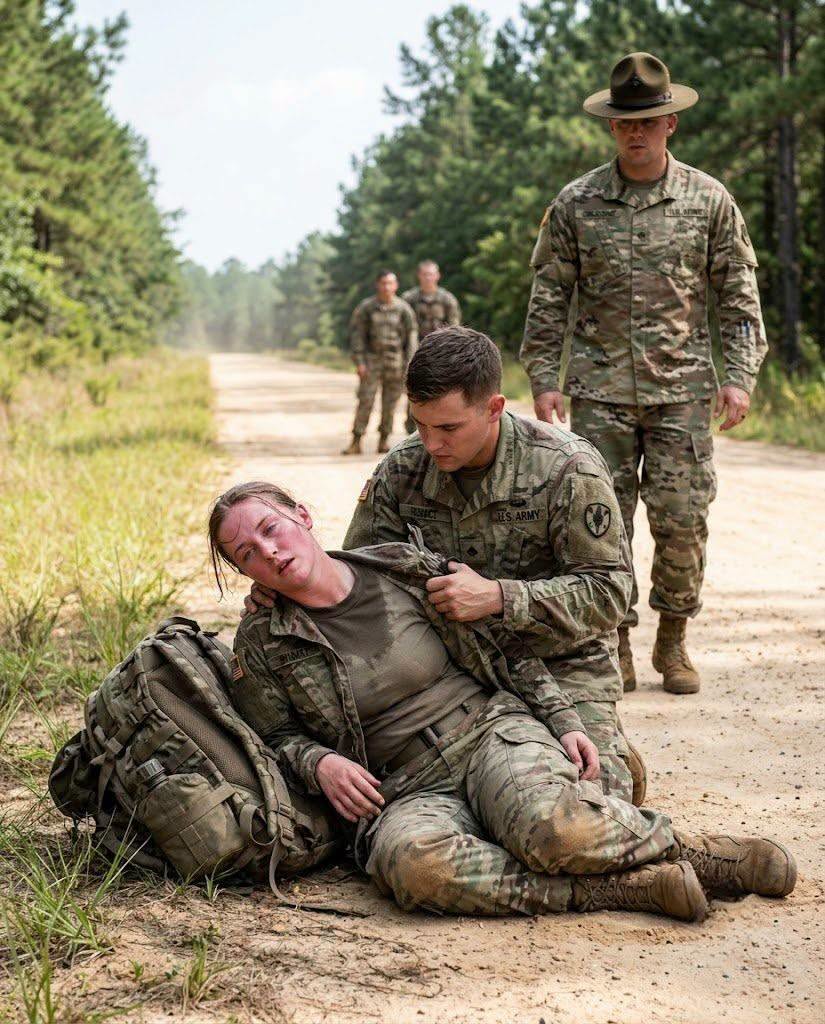
Pack inspections.
Formation comments.
The jokes about apologizing to the enemy.
The comments about me hiding something.
I expected her to tell me that selection was supposed to be hard, that drill cadre raised their voices, that discomfort was part of the job.
Instead, she asked a different question.
“Did he ever refer his concerns to medical?”
“Not that I know of.”
“Did he ever ask another evaluator to assess you?”
“No, ma’am.”
“Did he ever tell you that you had failed a published standard?”
I thought about it.
That answer surprised even me.
“No, ma’am.”
Bennett shut the folder.
“All right.”
She stood.
“Rest.”
At the door, she stopped.
“And Mercer?”
I looked at her.
“Your medical history is not platoon entertainment.”
After she left, I stared at the blank wall for a long time.
That afternoon Daniels came by carrying a clean uniform shirt from my locker and a plastic bag with the rest of my GEAR.
He set it on the chair.
Then he stood there awkwardly, hands at his sides.
“Can I ask something?”
I already knew what it would be.
“Go ahead.”
He glanced at the covered part of my shoulder.
“Why didn’t you tell us?”
I almost laughed.
“Tell you what?”
“About the burns. I mean… if Vega thought there was something wrong and nobody knew—”
He stopped when he saw my face.
For six weeks Daniels had never mocked me directly. But he had laughed sometimes. Looked away other times. Done what most people do when cruelty isn’t aimed at them.
Now, for one moment, he was still treating my privacy like part of Vega’s defense.
“Medical knew,” I said. “The people who needed to know knew.”
Daniels stared at the floor.
Then he nodded.
“You’re right. That was stupid.”
He picked up the clean shirt, unfolded it, and laid it where I could reach it.
“For what it’s worth, you weren’t the one falling behind most days.”
I looked at him.
“What does that mean?”
He hesitated.
“It means some of us started keeping track.”
That was all he said.
Two days later I found out what he meant.
Captain Bennett called Hayes, Daniels, and three other recruits into separate interviews. Then she pulled our weekly score sheets.
Selection had objective marks for most major events: run times, load carries, weapons handling, land navigation, obstacle completion, ruck pace.
My numbers weren’t extraordinary.
They didn’t need to be.
They were passing.
Consistently.
On some events, I was in the middle of the platoon. On two, I was near the top third. On one heavy carry, I had finished seven seconds behind Daniels and almost a minute ahead of two men Vega had never publicly questioned.
Yet Vega’s narrative comments told another story.
Lacks physical confidence.
Questionable durability.
May be concealing limitation.
Unsuitable for continued selection if pattern persists.
The pattern Bennett found wasn’t in my performance.
It was in his notes.
Every time my objective score met the standard, his comments moved the argument somewhere the numbers couldn’t answer.
I wasn’t too slow.
I looked hesitant.
I wasn’t too weak.
I appeared fragile.
I hadn’t failed.
I might fail later.
And because he had never referred his suspicion to medical, nobody with the authority to answer it had been asked.
He had turned suspicion into an evaluation category of his own.
When Bennett confronted him, I wasn’t in the room.
Hayes later told me only what he had personally heard from outside the office.
Vega insisted he had been testing my resilience.
Bennett asked whether he used the same test on everyone else.
Then the door closed.
For the next week, nothing seemed to happen.
That was the part I wasn’t prepared for.
Vega stopped leading our platoon, but nobody told us why. Another instructor took over. My medical profile remained temporary while the raw skin under the strap healed. I watched the rest of the group continue training while I was sent to modified conditioning and follow-up appointments.
I had survived the march.
I had been cleared before it.
People had finally looked at the records.
And I still thought I might lose my place.
One evening I sat outside the barracks with my replacement jacket folded beside me, staring at the tiny holes where the old collar had been cut apart by shears.
I had spent years believing that if I worked hard enough, pain could stay private.
The fire had happened when I was sixteen.
No dramatic rescue. No secret medal. No heroic story I had been waiting to reveal.
A faulty space heater ignited a curtain in the apartment where my mother and I lived. Smoke filled the hallway before either of us understood what was happening. I made it out.
Not cleanly.
Months of grafts followed. Then stretching. Physical therapy. Pressure garments. More surgery. People speaking slowly around me as if burned skin had damaged my hearing too.
By nineteen, I could run again.
By twenty-one, I could lift without guarding my left side.
The scars stayed.
So did the way people looked at them.
That was why I had buttoned the collar.
Not because I was ashamed of surviving.
Because I was tired of survival becoming the first thing anyone knew about me.
