
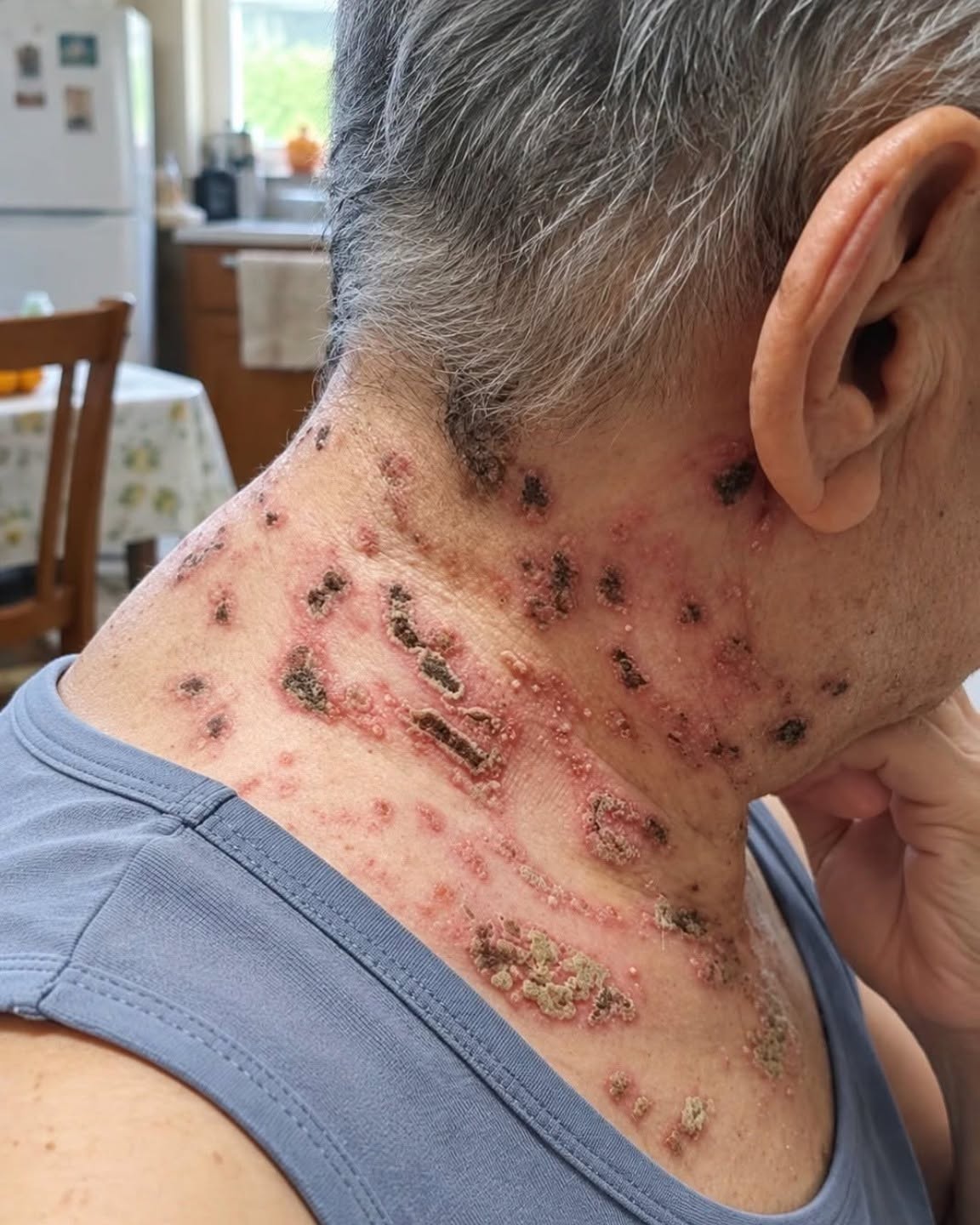
The Complication People Often Fear Most
One of the most important complications of shingles is postherpetic neuralgia (PHN).
This occurs when nerve pain continues after the skin rash has healed.
The pain may last for weeks, months, or, in some people, much longer.
It can feel like:
- Burning
- Shooting pain
- Electric shocks
- Extreme sensitivity
- Persistent aching
The risk of postherpetic neuralgia increases with age and is also associated with more severe acute pain and rash.
This is another reason shingles should not simply be dismissed as an ordinary skin rash.
Shingles Can Be Mild, Too
Not everyone experiences the dramatic symptoms sometimes shown in photographs.
Some people develop relatively mild rashes.
Others may experience significant nerve pain.
Rarely, people can experience nerve pain without an obvious rash, a condition sometimes referred to as zoster sine herpete.
This can make diagnosis more challenging.
For that reason, it is important not to assume that every case of shingles will look exactly the same.
What Should You Do If You Think You Have Shingles?
If you develop unexplained localized burning, tingling, or pain followed by a cluster of blisters—particularly on one side of the body—contact a healthcare professional.
Do not deliberately pop the blisters.
Keep the affected skin clean and avoid unnecessary touching.
Wear loose clothing if the area is sensitive.
Cold, damp compresses may provide some relief for discomfort.
Over-the-counter pain medication may also be appropriate for some people, but individual medical conditions and medications should be considered.
If you are uncertain whether a medication is safe for you, ask a doctor or pharmacist.
When Shingles Becomes an Urgent Problem
Seek prompt medical care if shingles is suspected and:
The rash is near the eye or on the face.
You develop vision changes or significant eye pain.
You experience facial weakness.
You develop severe headache, confusion, weakness, or other neurological symptoms.
You have a significantly weakened immune system.
The rash is widespread or rapidly worsening.
You develop signs of a secondary bacterial infection, such as increasing redness, warmth, swelling, pus, or worsening pain.
These situations can require more urgent assessment.

Can Shingles Be Prevented?
Yes.
Vaccination is an important way to reduce the risk of shingles and its complications.
The recombinant zoster vaccine (Shingrix) is recommended for certain adults, particularly older adults and people with specific immune-system risks, according to local vaccination guidelines.
Recommendations vary by country and individual circumstances.
Even if someone has had shingles before, vaccination may still be recommended because shingles can occur more than once.
Ask a healthcare professional whether you are eligible.
Don’t Mistake Every Rash for Shingles
While recognizing shingles is useful, it is equally important not to diagnose yourself solely from an online photograph.
Other conditions can resemble shingles, including:
- Contact dermatitis
- Insect bites
- Eczema
- Herpes simplex
- Bacterial skin infections
- Fungal infections
- Other inflammatory skin disorders
The location, appearance, progression, pain pattern, medical history, and sometimes laboratory testing all help establish the diagnosis.
The Bottom Line
Shingles can be easy to miss at the beginning because its first symptoms may have nothing obvious to do with a skin rash.
Burning, tingling, itching, unusual sensitivity, or localized pain may appear before the characteristic rash develops.
Then, in many cases, a cluster of fluid-filled blisters appears in a band or patch, often on one side of the body.
Recognizing this pattern matters because early medical evaluation can allow appropriate antiviral treatment to be started promptly and can help reduce the risk of complications.
Most importantly, don’t ignore a painful or unusual rash—especially if it appears on the face, around the eye, or alongside neurological symptoms.
And remember: not every rash is shingles, and not every case of shingles looks the same.
If something on your skin suddenly feels unusually painful, sensitive, burning, or tingling—particularly when the symptoms are localized to one side of the body—it is worth paying attention.
Sometimes, the first warning sign isn’t what you see on your skin. It’s what you feel underneath it.
