
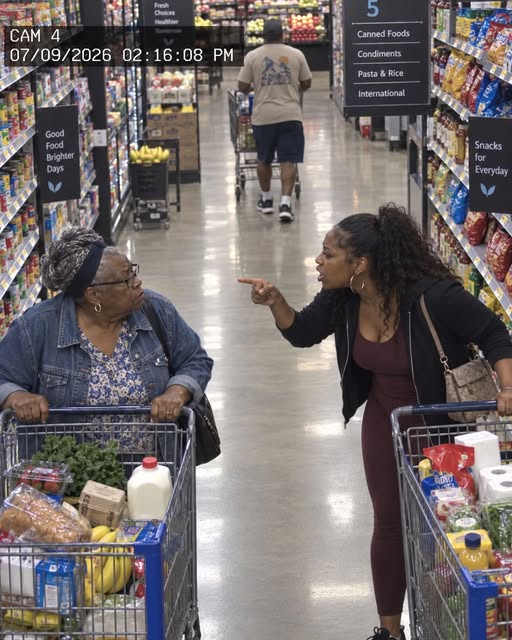
The single act that had fed hundreds of people for nineteen years was so unremarkable to my mother that she couldn’t even remember doing it.
That’s who she’d been my whole life, and I never knew, because the truly kind don’t keep records. They just pay for the cart and tell you to pass it on and disappear before you can catch their name.
Walter, the manager, made an announcement over the store’s intercom.
He told the whole store what had happened. That the woman who started the fund that had quietly helped so many of them was standing at register four.
And the store — the actual grocery store, on a Saturday — broke into applause.
My 83-year-old mother stood there in her cardigan, holding six items and a box of nineteen years of gratitude, and she looked at me, bewildered, and she said the most my-mother thing she could have possibly said:
“Diane, I only bought some bread and milk. I don’t understand what all the fuss is about.”
“I know, Mom,” I said, crying. “That’s exactly why they’re clapping.”
PART 5 — FINAL
They didn’t let my mother pay for her six items.
Elena wouldn’t hear of it. “Your money’s no good here, Margaret. It hasn’t been for nineteen years. You just didn’t know.”
We took the box home.
That night, my mother and I sat at her kitchen table and read the notes. All of them. Hundreds of them, nineteen years of strangers’ handwriting, thanking a woman who never knew they existed.
“I was a single mom and my card declined and someone from the Margaret Fund covered it. I cried in the parking lot. Thank you, whoever you are.”
“I’m a veteran on a fixed income. Some months are hard. This fund got me through more than one. God bless the woman who started it.”
“I was nineteen and broke and hungry and too proud to ask. The cashier just quietly covered my groceries and said it was from the Margaret Fund. I’ve never forgotten. I pay into it now.”
My mother read every one.
And somewhere around the fiftieth note, she stopped crying and started laughing — that soft, bewildered laugh of hers — and she said, “All I did was pay for one girl’s groceries. I’d forgotten it entirely. And look what everyone else did with it.”
“You started it, Mom.”
“No, sweetheart,” she said, and she was suddenly very clear, the way she got when something mattered. “I paid for one cart. Elena started it. She’s the one who came back and left the first twenty dollars. All the other people are the ones who kept it going.
I just did one small thing, one Saturday, and forgot about it.
The town did the rest.
That’s the secret nobody tells you about kindness, Diane. You don’t have to do a big thing. You just have to do one small thing and let go of it completely, and then get out of the way, because kindness is the only thing in this world that grows faster when you stop watching it.”
My mother passed away two years later.
Peacefully, at eighty-five, in her sleep, the way the good ones sometimes get to go.
Her funeral was small — she’d have wanted small.
Except it wasn’t small.
Because Elena came, and Walter came, and then person after person after person came, people I’d never met, people my mother had never met, people who’d been helped by a fund started by a woman who paid for one cart of groceries and told a stranger to pass it on.
The church was full.
Hundreds of people, at the funeral of a quiet old woman who’d have insisted she was nobody special.
Elena spoke.
She told the story of the declined card and the kind eyes and the words that changed her life: You pay it forward, to the next person who’s staring at the floor. That’s how this works.
“Margaret thought she was ordinary,” Elena told the packed church. “She was the least ordinary person I ever met. She proved that one small kindness, done without any hope of reward and then completely forgotten, can outlive the person who did it and feed a whole town for decades.
We’re all here because of one cart of groceries.
Imagine what she never even knew she did.”
The Margaret Fund still runs.
It’s official now — the store made it a real charity, in her name, and it’s spread to other stores in other towns. Elena runs the whole thing. Last I heard, it had helped thousands of people across the state.
I keep the box.
The original cardboard box, nineteen years of thank-you notes, plus all the ones that have come since.
Sometimes, when the world feels cruel — when I see someone sigh at an old woman with trembling hands, when I hear someone say “I’m just saying what everyone’s thinking” — I take out the box, and I read a few of the notes, and I remember what my mother taught me without ever meaning to teach me anything.
You don’t have to be remarkable.
You just have to pay for the cart.
And tell them to pass it on.
And then forget you ever did it, and get out of the way, and let kindness do the thing it does, which is grow, quietly, for nineteen years, until one Saturday it looks up from a register and recognizes your face and says the four best words a cruel world can hear:
Nobody leaves.
