
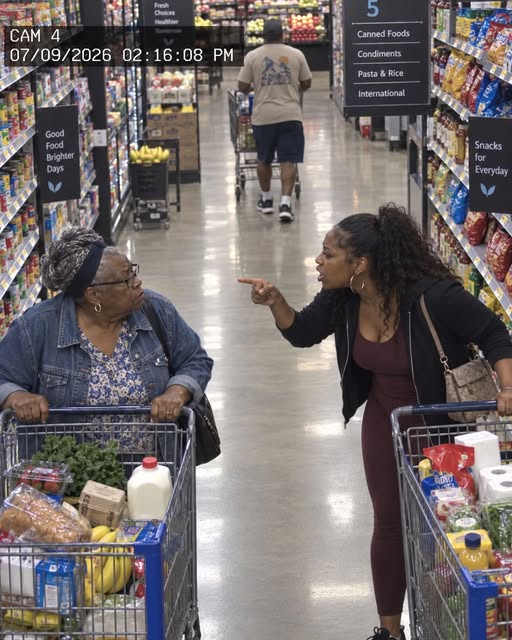
“You never thought anyone would remember,” Elena said. “But we all did.
That’s what’s in the box.”
PART 3
The manager — an older man named Walter who’d worked at that store for thirty years — opened the cardboard box on the counter.
Inside was a thick stack of envelopes, cards, and papers, soft with age.
“After you helped Elena,” Walter said, “she came back the next week and left a thank-you note here, hoping we’d know who you were. We didn’t — you’d paid cash, no name.
So we kept the note.
And then something happened that none of us expected.”
He lifted the first envelope.
“Elena paid it forward. When she got back on her feet. She started leaving twenty dollars here every month — ‘for the next person whose card declines,’ she said. She called it the Margaret Fund, even though she didn’t know your last name. She just remembered you said your name was Margaret when the manager back then asked.
And then other people heard about it.
And they started adding to it.”
He gestured at the box.
“Nineteen years, Margaret. Every note in this box is from someone who was helped by a fund that exists because you paid for one stranger’s groceries and told her to pass it on.
We’ve quietly covered groceries for hundreds of people in this town. Single parents. Old folks on fixed incomes. Kids who came up short. Anyone staring at the floor.
We kept every thank-you note, hoping that someday the woman who started it would walk back through those doors so we could show her what she did.
We’d almost given up.
And then, this Saturday, an old woman with six items and trembling hands came to Elena’s register, and a rude customer said something cruel, and Elena looked up at the face she’d been carrying for nineteen years.”
Elena took my mother’s trembling hands in both of hers.
“You paid for my groceries when I had nothing,” she said. “And it turned into a thing that’s fed this whole town for nineteen years.
You didn’t just help me, Margaret.
You started something that never stopped.”
The rude woman — the one who’d told my 83-year-old mother to stay home if she was too old to shop — had gone very quiet.
The entire checkout line had gone quiet.
And then, one by one, people in that line began to do something.
An old man two carts back said, “I got helped by that fund. Three winters ago. I didn’t know who to thank.” His voice broke. “Thank you, ma’am.”
A young mother near the front said, “My family too. When my husband lost his job.” She was crying. “Thank you.”
One after another, in a packed grocery store on an ordinary Saturday, people my mother had never met and never would remember stood up to thank a trembling 83-year-old woman for a kindness that had rippled through their lives without her ever knowing.
PART 4
The rude woman tried to leave.
She pushed her overflowing cart toward another register, her face red, muttering about being in a hurry.
And here’s the part I’m proudest of — not of my mother, who was too overwhelmed to notice, but of the town.
Elena stopped her. Not unkindly.
“Ma’am,” Elena said. “You don’t have to stay. But before you go — you said what everyone here was thinking.
You were wrong.
What everyone here was thinking is that they’d give anything to be the kind of person this woman is. The kind whose smallest kindness outlives them by decades.
You looked at an old woman with trembling hands and saw someone who should stay home.
We looked at her and saw the reason half this town made it through its worst winters.
That’s the difference between you and her.
It’s not age. It’s not speed at a register.
It’s what you do when someone’s staring at the floor.”
The woman left without her groceries. I don’t know where she went. I found I didn’t care.
Because I was watching my mother.
My mother, who I had spent my whole life thinking of as ordinary. Sweet, quiet, unremarkable Margaret, who did her own shopping and never made a fuss and never, in eighty-three years, once mentioned that she went around town quietly paying for strangers’ groceries when she could afford it, and never expected to be thanked, and had genuinely forgotten she’d ever done it.
That’s the part that undid me.
She’d forgotten.
