
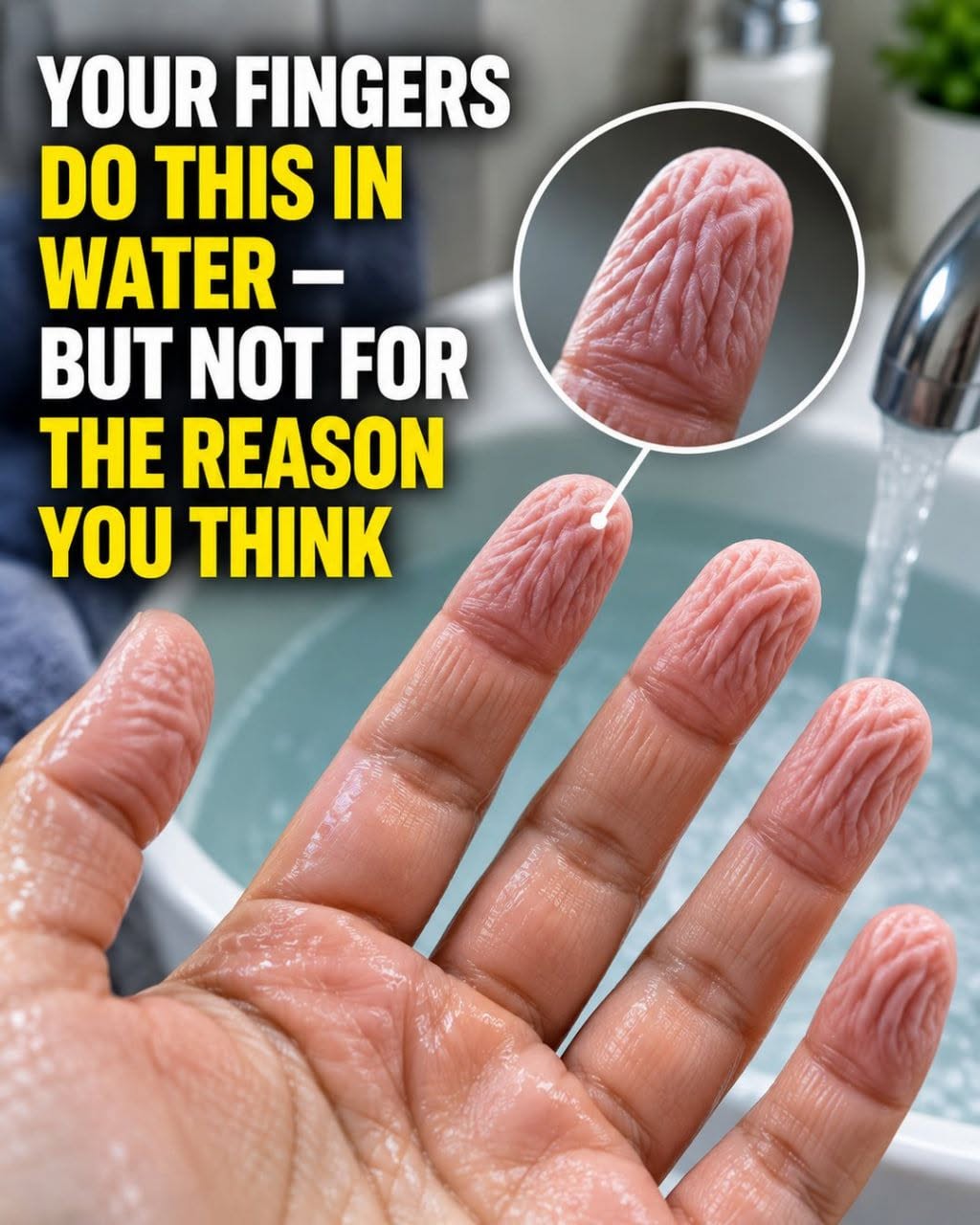
Fingerprints are permanent ridge patterns established before birth.
Water-induced wrinkles are temporary folds that appear after prolonged immersion.
Your fingerprints do not disappear simply because your fingertips become wrinkled.
The two patterns can overlap visually, which is one reason a close-up photograph of a wet fingertip can look so complex.
Do Your Fingerprints Change After a Bath?
The underlying fingerprint pattern remains.
Temporary swelling and wrinkling can alter the surface appearance, but once the fingers dry and return to their normal condition, the familiar ridge pattern remains.
This highlights the difference between permanent anatomical structures and temporary physiological responses.
Why Doesn’t Your Entire Hand Wrinkle the Same Way?
The palm can show changes after prolonged water exposure, but the dramatic “pruney” appearance is particularly obvious on the fingertips.
Skin differs significantly across the body.
The thick, hairless skin on the palms and soles has specialized characteristics suited to gripping, touching, and bearing mechanical stress.
So it should not be surprising that it responds differently from the thinner skin covering areas such as the forearm.
What Does This Tell Us About the Human Body?
Perhaps the most interesting lesson has little to do with wrinkles themselves.
The phenomenon shows how difficult it can be to explain the body based solely on appearance.
The obvious explanation — “the skin just absorbs water” — sounds perfectly reasonable.
Only closer investigation reveals the hidden role of nerves and blood vessels.
The same principle applies throughout human physiology: many ordinary things happening on the surface are controlled by surprisingly complex systems underneath.
Other Automatic Responses You Rarely Think About
Your pupils change size depending on light conditions.
Your body sweats when it needs to release heat.
Blood vessels widen or narrow in response to different conditions.
Your heart rate continually adjusts to activity, rest, emotion, and posture.
Most of these adjustments happen automatically.
Finger wrinkling belongs to this enormous collection of background processes that the nervous system manages without requiring conscious instructions.
Can You Stop Your Fingers From Wrinkling by Thinking About It?
No. You cannot normally switch the response off through willpower.
That is because the autonomic nervous system operates largely outside conscious control.
You can choose whether to put your hand in water, but once the conditions are right, the physiological response occurs automatically.
Does Everyone Wrinkle Exactly the Same Way?
No.
The depth, speed, and pattern of wrinkling can vary between individuals.
Age, skin characteristics, water conditions, temperature, duration of immersion, and physiological differences can all influence what you see.
This is why comparing your fingertips with someone else’s after swimming may reveal surprisingly different patterns.
Should You Worry About Ordinary Wrinkled Fingers?
If your fingertips become wrinkled after spending a long time in water and then gradually return to normal after drying, that is generally an ordinary physiological response.
It does not mean your fingers have absorbed a dangerous amount of water or that your skin is suddenly aging.
The wrinkles are temporary.
Changes that appear without water exposure, persist unexpectedly, or occur alongside other symptoms should not automatically be assumed to have the same explanation.
The Next Time You Take a Long Bath, Look Closely
Instead of simply noticing that your fingers look “old,” examine the pattern.
You may see channels running across the fingertips and deeper folds forming around areas that were smooth before immersion.
Then watch what happens after you dry your hands.
Over time, those folds begin disappearing.
You are watching a reversible response involving your skin, blood vessels, and nervous system unfold in real time.
Final Thoughts
Wrinkled fingers after a bath are much more interesting than they first appear.
The traditional idea that fingertips wrinkle simply because they soak up water is incomplete.
Prolonged water exposure triggers an active response involving the autonomic nervous system and narrowing blood vessels beneath the skin, which contributes to the distinctive wrinkled pattern.
Scientists have also investigated whether these wrinkles provide a functional advantage when handling wet objects, although the evolutionary explanation is still being studied and debated.
For most people, the effect is completely temporary and ordinary.
So the next time you step out of a pool and look down at your pruney fingertips, remember: you are seeing much more than wet skin.
You are watching your nervous system quietly change the surface of your fingers — without you having to think about it at all.
