
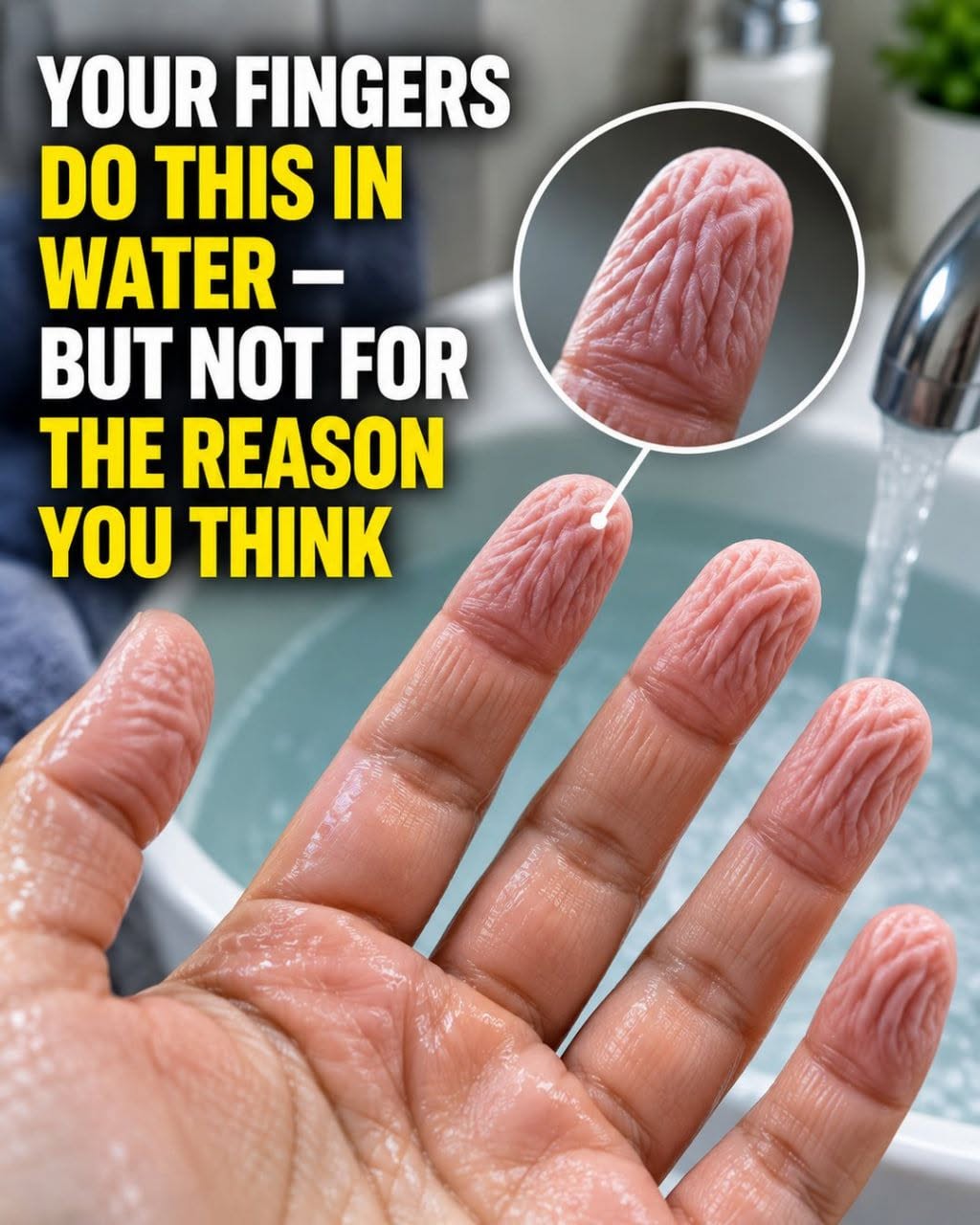
You have probably seen it hundreds of times. Spend long enough swimming, relaxing in a bath, washing dishes, or sitting in a pool, and the smooth skin on your fingertips begins to change.
Within minutes, deep little ridges and wrinkles appear. Your fingertips suddenly look dramatically older, and once you dry off, they gradually return to normal.
For generations, the common explanation seemed obvious: your skin absorbs water, swells, and becomes wrinkled.
But that explanation doesn’t tell the whole story.
Scientists have discovered that water-induced finger wrinkling involves an active response controlled by the nervous system. Blood vessels beneath the skin constrict, changing the volume of tissue underneath the surface and helping create those familiar folds.
In other words, those temporary wrinkles are not simply wet skin behaving like a sponge.
What Actually Happens to Your Fingers in Water?
When the skin of the fingers and toes stays in water for a while, signals involving the autonomic nervous system trigger blood vessels beneath the skin to narrow.
This process is known as vasoconstriction.
As the volume beneath the skin decreases, the outer surface does not shrink in exactly the same way. The result is a pattern of ridges and valleys that gives fingertips their familiar wrinkled appearance.
This helps explain why the effect is especially noticeable on fingers and toes rather than appearing equally across the entire body.
So Does the Skin Absorb Any Water?
Yes. The outermost layer of skin can interact with and absorb some water.
But simple water absorption is not considered a complete explanation for the distinctive wrinkling pattern on fingertips.
The nervous system plays an important role.
This distinction became clearer when researchers and physicians observed that normal water-induced wrinkling can be altered when certain nerves are damaged.
If wrinkling were caused entirely by passive water absorption, nerve function would not be expected to matter nearly as much.
Your Autonomic Nervous System Is Involved
The autonomic nervous system manages many processes that happen without conscious effort.
You don’t normally have to tell your body to adjust blood vessel diameter, regulate sweating, or perform countless other automatic functions.
Finger wrinkling in water is another example of how much is happening beneath the surface without you thinking about it.
You cannot simply decide to wrinkle your fingertips on command.
The response develops automatically under the appropriate conditions.
Why Does It Take Several Minutes?
Wrinkling does not usually happen the instant your hand touches water.
The response develops gradually after continued exposure.
The exact timing can vary depending on water temperature, the individual, skin condition, and other factors.
This is why one person’s hands may appear dramatically wrinkled after a bath while another person’s wrinkles seem less noticeable.
Why Do Fingers and Toes Wrinkle the Most?
One of the biggest clues is the location of the wrinkles.
If soaking alone caused the entire phenomenon, we might expect every submerged area of skin to develop equally dramatic folds.
Instead, the classic effect is concentrated on the fingers and toes, particularly the surfaces involved in gripping and contacting the ground.
That unusual distribution has inspired an intriguing scientific question.
Could Wrinkled Fingers Help Us Grip Wet Objects?
Researchers have explored the possibility that water-induced wrinkles may improve our ability to handle wet objects.
The idea is easy to visualize.
Look closely at a wrinkled fingertip. The ridges and channels resemble patterns that could help move water away from contact surfaces.
Some experiments have reported advantages when people handled wet objects with wrinkled fingers.
However, not every study has found the same performance benefit, so scientists continue to debate exactly how important this proposed function is.
It is therefore better to describe improved wet grip as an interesting evolutionary hypothesis rather than a completely settled explanation.
Are Finger Wrinkles Like Tire Treads?
You may encounter comparisons between wrinkled fingers and tire treads.
The analogy is attractive because both contain channels that could potentially help manage water between two surfaces.
But human skin is far more complicated than a tire.
The comparison can help illustrate the hypothesis, but it should not be treated as proof that finger wrinkles evolved for precisely the same mechanical reason.
Why Don’t Your Fingers Stay Wrinkled?
If wrinkles could potentially offer an advantage in wet environments, you might wonder why fingertips are not permanently shaped that way.
Smooth fingertips may provide advantages under dry conditions, and permanent deep folds could affect sensation or contact with surfaces.
The temporary nature of the response allows the skin to change under prolonged wet conditions and then return toward its usual state afterward.
Again, researchers continue studying the evolutionary reasons behind the response, but its reversibility is one of its most fascinating features.
And the way your fingers return to normal reveals another surprisingly sophisticated part of this everyday process.
What Happens When You Leave the Water?
Once your hands are removed from the water and begin drying, the stimulus associated with the wrinkling response disappears.
Blood vessel behavior changes again, tissue volume returns toward its normal state, and the wrinkles gradually fade.
For most people, the fingers eventually look just as they did before entering the water.
