
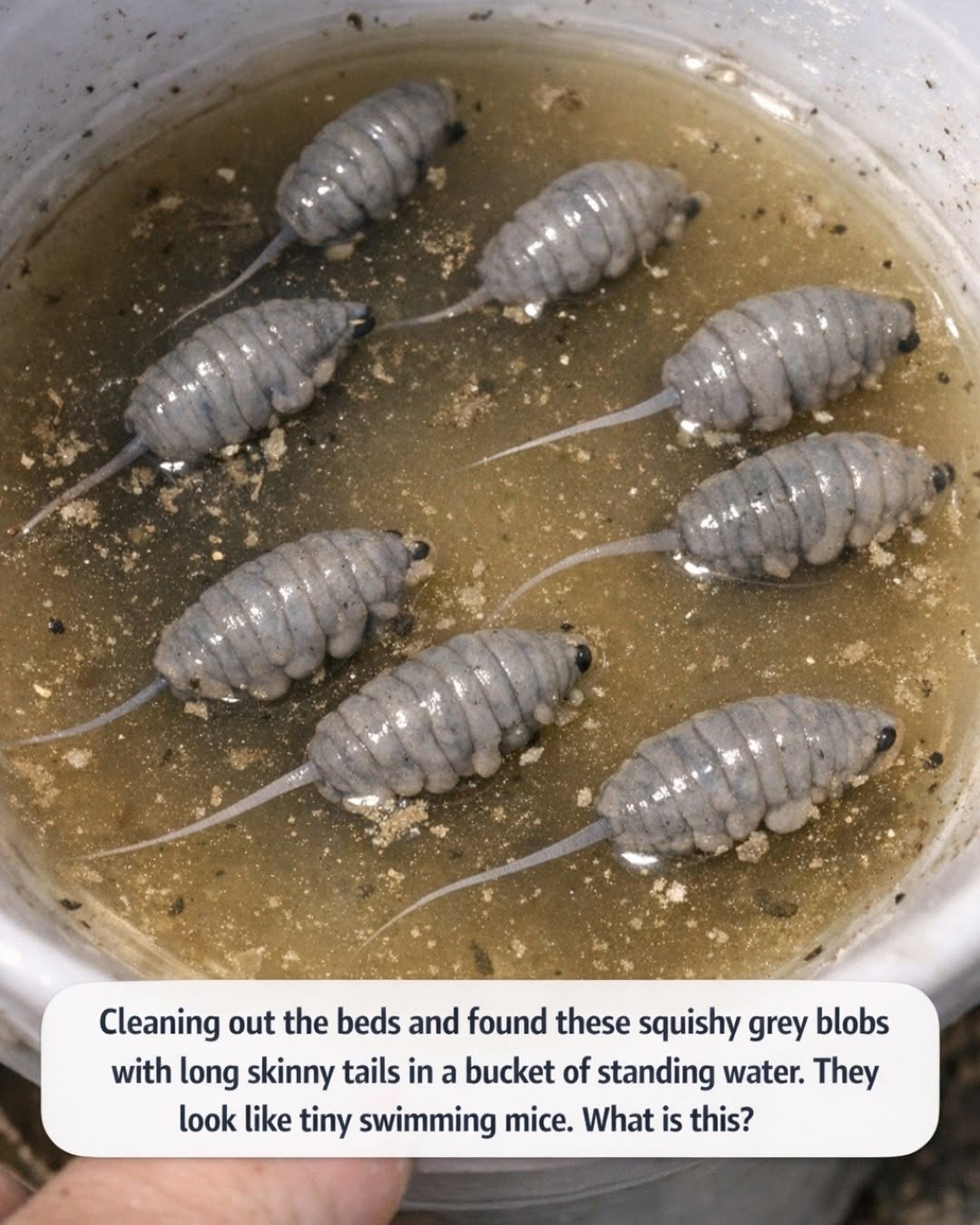
If you’ve ever tipped out a forgotten bucket in the garden and seen little greyish, squishy creatures wriggling around with what look like absurdly long tails, you’re not the first person to recoil and then immediately get curious. I’ve had readers describe them to me as “baby mice,” “swimming commas,” and “alien tadpoles,” but in most cases the answer is much less dramatic and much more common: they’re likely rat-tailed maggots, the larvae of certain hoverflies.
They look strange enough to inspire a bit of panic, especially when they turn
up in standing water near raised beds, compost, or a clogged container. The good news is that they are not rodents, not baby snakes, and not some new invasive horror. In this piece, I’ll walk you through what they are, why they show up, how to identify them, whether they’re dangerous, what they turn into, and what to do with that bucket of water so you don’t keep finding them again.
1. What you’re probably looking at
Those “tiny swimming mice” are most likely rat-tailed maggots, which are the aquatic
larvae of drone flies and related hoverflies in the genus Eristalis. The larva itself is usually about 1/2 inch to 3/4 inch long, sometimes close to 1 inch when fully grown, with a plump, legless, wrinkled body that can look grey, beige, brownish, or muddy depending on what it has been living in.
The “tail” is the giveaway. It is not actually a tail in the mammal sense. It’s a breathing tube called a siphon, and it can be as long as the body or even longer. In
some species, the full extended siphon can make the creature look 1 1/2 to 2 inches long overall. That long, skinny extension is what gives the larva its name.
2. Why they look like they have tails
That skinny “tail” is essentially a snorkel. Rat-tailed maggots often live in foul, stagnant, low-oxygen water full of decaying organic matter. Think old buckets, neglected wheelbarrows, clogged drains, manure runoff, soggy compost tea, or water trapped under rotting leaves. Because the water can be so oxygen-poor, the larva stays submerged and stretches
its siphon up to the surface to breathe air.
If you scoop one up or disturb the water, the siphon may contract, bend, or wag in a way that makes it look eerily alive all by itself. That’s part of why people find them so memorable. In still water, though, you can often watch the tube reaching toward the surface while the body hangs below like a little diver.
3. Where gardeners usually find them
In my experience, they nearly always turn up in places that have been left wet
and dirty for longer than anyone intended. A 5-gallon bucket half-full of rainwater and leaf sludge is a classic setup. So is a watering can with decomposing algae in the bottom, a birdbath that has gone untouched for weeks, or a planter saucer packed with drowned mulch.
They are especially common in late spring through early autumn, when temperatures regularly sit between about 60 and 85 degrees Fahrenheit and organic material breaks down quickly. If you were cleaning beds and had pulled weeds, rinsed tools, or let debris collect in
a container, you may have accidentally created ideal nursery conditions for them without realizing it.
4. How to identify them correctly
A rat-tailed maggot has a blunt, thick body with no obvious legs, a somewhat tapered front end, and a very narrow breathing tube extending from the rear. The body often appears segmented or ringed. When swimming, it may jerk, curl, or inch along the bottom rather than moving smoothly like a fish or tadpole.
They do not have fur, ears, paws, or visible mouse-like features despite the nickname people
give them. They also do not have the broad head and finned tail of a tadpole. If you gently pour the water into a shallow white tray, you can often see several larvae hanging vertically or bending into C-shapes. That combination of plump body plus retractable “tail” is the key field mark.
