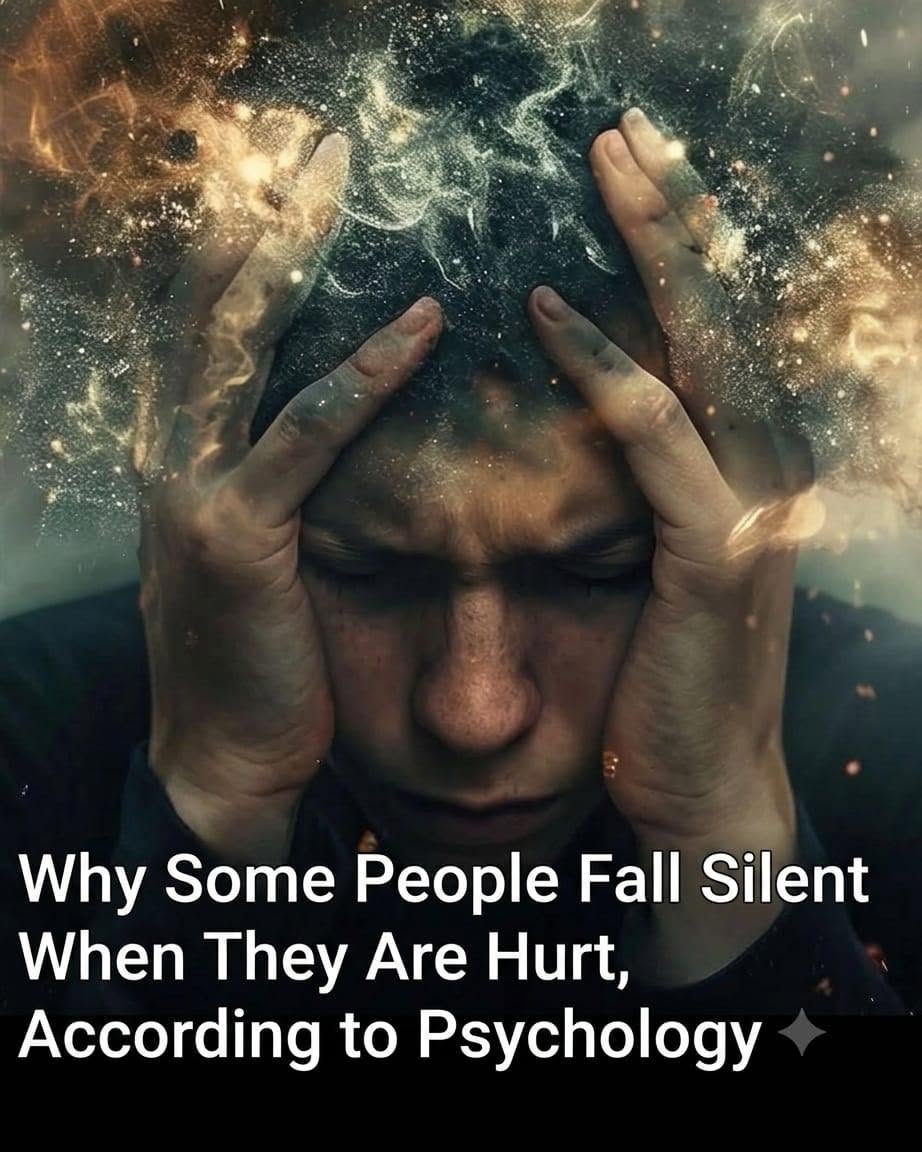
Why do some people remain silent when they are hurt?

Advertisement

Emotional withdrawal… Why some people remain silent when they are suffering

Most people think that silence means only one thing: anger.

A person stops responding to messages. They distance themselves after an argument. Their replies become shorter, colder, or even disappear completely.

The immediate conclusion is usually the same: “He/She is deliberately ignoring me.”

Sometimes, that’s true.

But often, that’s not the case.

What many interpret as rejection or punishment may in reality be something else entirely: a profound emotional upheaval.

The problem is that, from the outside, the two situations can appear almost identical.

Why is silence so difficult to live with?

Imagine sending a message to someone you care about and receiving no reply.

The hours pass. Then a day. Perhaps several days.

You see her active online. She responds to others, but not to you.

Almost immediately, your mind begins to fill in the gaps.

Uncertainty makes us uneasy, and when information is lacking, our brain naturally comes up with explanations.

Unfortunately, these explanations often lead to rejection.

“They’re angry with me.”

“I must have done something wrong.”

“They don’t care.”

However, psychology suggests that silence is often less intentional than we believe.

For some people, withdrawal is not a strategy.

It’s a reaction to stress.

And this distinction changes everything.

The difference between silence and emotional withdrawal.
The term “silence” is often used to describe any period of emotional distance.

But not all silences are created equal.

There is a significant difference between:

Refusing to communicate in order to control or punish someone

To withdraw because the emotions have become unbearable

One of them is manipulation.

The other is self-protection.

The problem is that most people have never learned to tell the difference.

Many of us grew up perceiving silence as a punishment.

Perhaps a parent stopped talking after an argument.

A partner withdrew their affection to send a message.

A friend suddenly became cold without explanation.

Over time, these experiences teach the brain to associate silence with abandonment.

In adulthood, our nervous system often reacts to withdrawal long before we consciously understand the cause.

Why does rejection hurt so much?

The pain of emotional withdrawal is not only emotional, it is also biological.

In a well-known study, neuroscientist Naomi Eisenberger discovered that social exclusion activates some of the same brain regions involved in physical pain.

In other words, being ignored is not only painful.

Your brain processes it in the same way as an injury.

This explains why emotional distance can trigger such intense reactions.

When a person distances themselves, the body often reacts as if facing a threat.

Fear, anxiety, and uncertainty are very real.

When silence is actually a response to stress

Relationship researcher John Gottman has devoted decades to studying conflict within couples.

His research has shown that during emotionally intense situations, some people are physiologically overwhelmed.

Advertisement

Their :

Heart rate increases.
Stop the stress.
Nervous system switches to survival mode.

Once this state is reached, communication becomes extremely difficult.

The brain is no longer focused on the connection.

He is focused on protection.

It is at this point that many people withdraw into themselves.

Not out of indifference.

Because they can no longer process additional emotional information.

The shock reaction: the survival mode no one talks about

Most people are familiar with the “fight or flight” response.

A lesser-known third survival reaction is shock.

According to the work of neuroscientist Stephen Porges on the regulation of the nervous system, when the brain perceives intense stress and sees no way out, it may choose to withdraw into itself.

People who experience a shock reaction often become:

Silent
, emotionally insensitive,
mentally distant
, less expressive
. From the outside, they may appear cold or indifferent.

Internally, however, they may feel overwhelmed by emotions that they are unable to organize or express.

What appears to be a disconnection may actually be an emotional overload.

How childhood influences withdrawal in adulthood

Many emotionally distant adults learned early on that expressing their emotions was dangerous.

Perhaps they were criticized for showing their feelings.

Perhaps their concerns were minimized or ignored.

Over time, the brain adapts.

He learns that vulnerability breeds discomfort rather than support.

The work of psychologist Martin Seligman on learned helplessness helps to explain this process.

When people repeatedly experience situations where their voice doesn’t matter, they eventually stop speaking up.

Not out of indifference, but because they have learned not to expect understanding.

In adulthood, this can create a withdrawal behavior during conflicts, even when strong emotions are present in the background.

The role of attachment styles

Attachment theory offers another explanation for emotional withdrawal.

People with an avoidant attachment style often develop what psychologists call deactivation strategies.

These are unconscious mechanisms aimed at reducing emotional closeness when vulnerability becomes uncomfortable.

When conflict arises or intimacy intensifies, their nervous system may interpret these experiences as threats.

The consequence?

Distance. Silence. Withdrawal.

Often without fully understanding why they act this way.

Many people with an avoidant attachment style do not intentionally push others away.

Their brains simply learned long ago that emotional distance is more reassuring than emotional exposure.

Why does withdrawal affect everyone?

Silence rarely affects only one person.

Research shows that when a person suppresses their emotions during an interaction, the other person’s stress level often increases as well.

Human beings need emotional feedback to feel safe.

We pay attention to:

Facial expressions,
tone of voice,
emotional reactivity,
non-verbal cues:
when these signals disappear, uncertainty sets in.

Even without words, silence conveys a message.

Unfortunately, this message is often interpreted as a rejection.

The cycle of pursuit and withdrawal

Couples therapist Sue Johnson describes a common pattern called the chase-and-withdraw cycle.

Here’s how it works:

A person withdraws emotionally.

The other person feels anxious and seeks reassurance.

The pressure becomes even greater for the partner who withdraws.

He/She withdraws further.

The anxious partner insists even more.

And the cycle continues.

Everyone is trying to protect themselves.

One fears abandonment.

The other fears being overwhelmed by their emotions.

However, each person’s coping strategy unintentionally intensifies the other’s deepest fear.

Silence is not always innocent

It is important not to idealize all withdrawals.

Sometimes, silence is used as a weapon.

Some people intentionally withhold communication to punish, manipulate, or gain control.

This type of silence usually implies power dynamics.

Communication resumes only when the desired reaction has been obtained.

Studies have established a link between chronic emotional withdrawal and increased anxiety, depression, and emotional distress in relationships.

That’s why context is important.

Relational patterns are important.

And your own experience.

That matters.

A person overwhelmed by their emotions tends to withdraw into themselves in many situations.

A person who uses silence as a tool for manipulation often employs it strategically.

What should you do when a person withdraws into themselves?

Contrary to what many believe, pressure rarely resolves emotional withdrawal.

In reality, demands for immediate communication often intensify withdrawal reactions.

For a person overwhelmed by their emotions, more pressure can be perceived as an increased danger.

A calmer approach is often more effective.

A simple phrase like: “I’ve noticed you’ve been quiet lately. I’m here when you’re ready to talk.”

This demonstrates your support without creating additional pressure.

This provides a sense of security rather than a sense of urgency.

Of course, compassion does not mean indefinitely tolerating unhealthy behavior.

Everyone is responsible for learning to communicate in a healthier way.

But when silence is motivated by suffering rather than manipulation, understanding is often more constructive than confrontation.

The importance of context

One of the most painful aspects of withdrawing into oneself is uncertainty.

We naturally tend to fill in the gaps, and these assumptions are often negative.

That’s why even a small explanation can make all the difference.

You don’t need to explain everything perfectly.

You don’t need to manage your emotions immediately.

Sometimes, simply saying, “I need some time, but I’ll get back to you when I’m ready” is enough.

Out of context, silence is perceived as abandonment.

With context, he is perceived as a human being.

Recovery is possible.

The good news is that this withdrawal into oneself is not permanent.

Research suggests that the brain can learn new patterns when it repeatedly experiences emotional security.

Healing often happens through small moments:

Speaking and being heard.
Expressing emotions without being judged.
Experiencing vulnerability without being rejected.
Discovering that conflicts do not always lead to suffering.

Over time, these experiences help to change the expectations of the nervous system.

The brain begins to understand that contact is not always dangerous.

And little by little, silence becomes less necessary.

Conclusion

Silence isn’t always synonymous with anger. Sometimes it expresses fear. Sometimes it expresses a feeling of being overwhelmed. Sometimes it reflects years of conditioning, attachment patterns, or nervous system reactions that developed long before the current relationship.

Understanding this does not excuse harmful behavior.

But it can help us perceive emotional withdrawal with greater clarity and compassion.

Because behind many moments of silence, there is not a person who seeks to hurt others.

This is a person who tries – often clumsily – to protect themselves.

And for many, healing begins when they realize they no longer have to endure every conversation.

Advertisement

Leave a Reply

Your email address will not be published. Required fields are marked *