
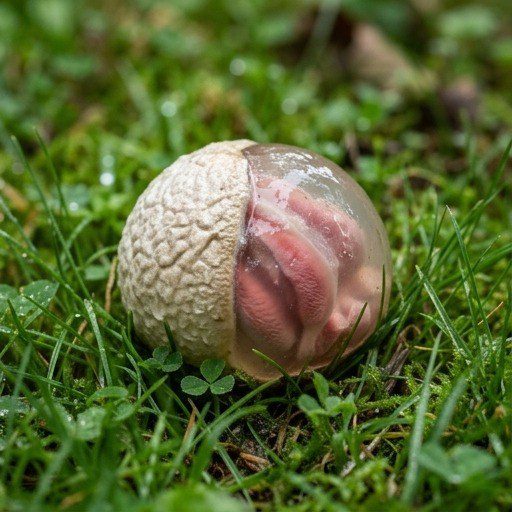
Is It Dangerous?
The Devil’s Fingers mushroom is not considered toxic in any clinically significant sense, though it is absolutely not recommended for eating — not because it would cause serious harm, but because the smell alone would make any attempt to prepare or consume it essentially impossible. The fungus is harmless to humans and animals in direct contact, and simply touching it, while unpleasant given the slime and the smell, carries no known health risk. It is not a parasite, it does not infect plants or soil in any harmful way, and its presence in a garden, while startling, does not indicate any underlying problem with the soil or the health of surrounding plants.
If you find one in your garden and want to remove it, the most practical approach is to dig it up entirely — including as much of the underground mycelium network as is practical to remove — and dispose of it in sealed waste rather than composting it, as composting could potentially spread the spores. Wearing gloves is advisable simply for comfort. The fungus tends to appear after periods of wet weather and is most commonly found in areas where organic material is decomposing in the soil — wood chips, buried wood, leaf litter, and similar substrates are typical sites of emergence. Removing or reducing these organic substrates can reduce the likelihood of recurrence, though it cannot guarantee it, as the mycelium can spread underground before the fruiting body emerges.
Nature’s Most Unsettling Trick
I have thought about what I saw that morning many times since then. The thing that stays with me most is not the shock of the initial discovery, or even the relief of finding out it was something explicable. It is the realization of how thoroughly and brilliantly the fungus has solved its biological problem. It needs to spread its spores. It cannot move. It cannot call out or signal in any way that would attract a suitable carrier. So over millions of years of evolution, it developed a solution that is, from a purely functional standpoint, genius: it made itself look and smell exactly like the thing that the creatures it needs to attract find most irresistible. It built itself into something that every fly in the vicinity cannot resist investigating. It disguised itself as death itself.
Nature is full of remarkable adaptations, but few are as viscerally effective — and as immediately, personally impactful on any human who stumbles across one — as the Devil’s Fingers fungus doing its work in a quiet corner of a garden on an ordinary morning. I still avoid that corner of the yard. I still remember the smell. And I still find myself, whenever I am in the garden, glancing toward the flowerbed in the corner before I start watering the flowers, just to make sure there are no red claws stretching up from the earth. Because now I know they are out there. And now I know they will come back, if the conditions are right. And now I know, though it does not make it any less alarming to see, exactly what they are.
