
At first glance, this riddle seems impossible.
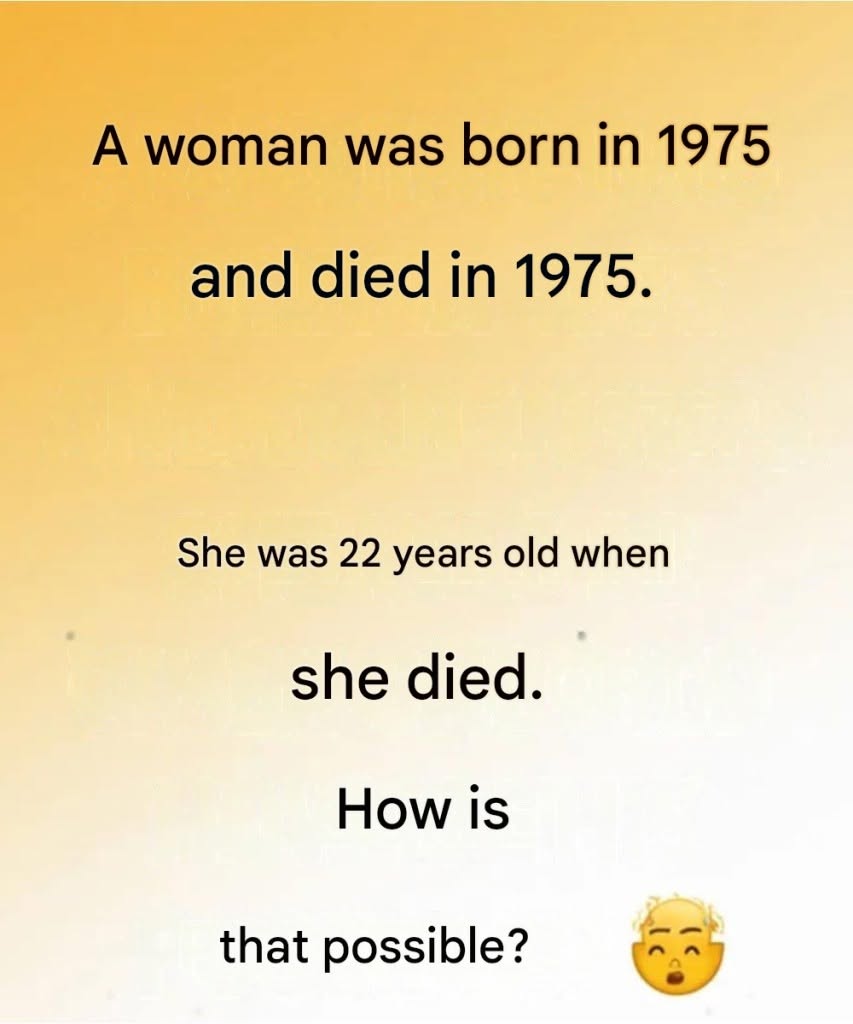
A woman was born in 1975 and died in 1975, yet she was 22 years old when she died.
Most people immediately think there must be a mistake. How can someone be born and die in the same year while living for 22 years? The math simply doesn’t work.
But this classic brain teaser is designed to challenge the way we think. The trick is hidden in a simple assumption that most readers make without realizing it.
In this article, we’ll break down the riddle, explain the solution, explore why our brains get fooled, and look at what this puzzle teaches us about critical thinking.

The Riddle
Here is the puzzle exactly as it is usually presented:
A woman was born in 1975 and died in 1975.
She was 22 years old when she died.
How is that possible?
Take a moment and think about it.
Most people begin calculating ages immediately.
If she was born in 1975 and died in 1975, then she could only have lived for a few months at most.
So how could she possibly be 22 years old?
The Common Mistake
The reason this puzzle is so effective is because almost everyone assumes the number 1975 refers to a year.
Our brains automatically interpret four-digit numbers as years because that’s how we usually see them.
When someone says:
- Born in 1985
- Graduated in 2007
- Died in 2024
We naturally think about dates and timelines.
The riddle takes advantage of this habit.
The puzzle never actually says that 1975 is a year.
It only says she was born in 1975 and died in 1975.
That’s a very important distinction.
The Solution
The answer is surprisingly simple:
1975 was not a year—it was a room number, house number, hospital room, address, or some other numbered location.
For example:
- The woman was born in room 1975 of a hospital.
- Twenty-two years later, she died in room 1975 of another building.
In this interpretation:
- “Born in 1975” means she was born in a place identified by the number 1975.
- “Died in 1975” means she died in a place identified by the same number.
Since the number is not a year, there is no contradiction.
The woman could easily have been 22 years old when she died.
Mystery solved.
Why This Riddle Tricks So Many People
The real brilliance of the puzzle lies in psychology.
Human brains are designed to recognize patterns quickly.
When we see a four-digit number, especially one that resembles a year, our minds instantly categorize it.
This process happens so fast that we don’t even notice it.
Psychologists call this a mental shortcut or cognitive bias.
These shortcuts help us make decisions quickly, but they can also lead us to incorrect conclusions.
In this case, the shortcut causes us to assume:
- 1975 = a year
Once we make that assumption, the puzzle becomes impossible.
The only way to solve it is to question the assumption itself.
The Power of Hidden Assumption
This riddle teaches an important lesson:
Sometimes the problem isn’t the information we’re given.
The problem is the information we assume.
Many puzzles work this way.
They rely on hidden assumptions that seem obvious but aren’t actually stated.
For example:
- We assume numbers represent years.
- We assume words have only one meaning.
- We assume situations follow everyday patterns.
When those assumptions are challenged, the solution suddenly becomes clear.
What This Puzzle Teaches About Critical Thinking
Although it appears to be just a fun brain teaser, it actually demonstrates a valuable life skill.
Critical thinking requires us to examine our assumptions.
Instead of accepting the first interpretation that comes to mind, we should ask:
- What am I assuming?
- Is there another way to interpret the information?
- Have I overlooked a possibility?
People who develop this habit often become better problem-solvers because they are less likely to get trapped by their initial impressions.
Real-Life Examples of Similar Thinking
The same type of thinking appears in everyday life.
Business Decisions
Companies sometimes fail because they assume customers want one thing when they actually want something else.
The assumption becomes the problem.
Scientific Discoveries
Many scientific breakthroughs occurred because someone questioned a widely accepted belief.
Instead of asking, “How does this fit what we already know?”
Scientists asked:
“What if our assumption is wrong?”
Personal Relationships
Misunderstandings often happen because people assume they know what someone meant.
Taking time to question those assumptions can prevent unnecessary conflict.
Other Classic Riddles That Use the Same Trick
This puzzle belongs to a category of riddles that rely on misleading assumptions.
Here are a few famous examples.
The Doctor Riddle
A boy and his father are in a car accident.
The father dies.
The boy is rushed to the hospital.
The doctor sees him and says:
“I can’t operate on him. He’s my son.”
How is this possible?
The answer: The doctor is the boy’s mother.
Many people mistakenly assume the doctor is male.
The Egg Riddle
If a rooster lays an egg on the roof of a barn, which side does the egg roll down?
The answer:
Roosters don’t lay eggs.
Again, the puzzle works because it encourages a false assumption.=
The Elevator Riddle
A short man lives on the 20th floor.
Every day he takes the elevator up to the 10th floor and walks the rest of the way.
Why?
Because he cannot reach the button for the 20th floor.
The explanation is unexpected because most people assume there must be a more complicated answer.
Why People Love Brain Teasers
Brain teasers remain popular because they create a moment of surprise.
At first, the puzzle appears impossible.
Then suddenly the answer becomes obvious.
That “aha!” moment is satisfying because it rewards creative thinking.
Research suggests that solving puzzles can:
- Improve problem-solving skills
- Strengthen memory
- Encourage flexible thinking
- Boost mental focus
- Provide enjoyable mental exercise
Even simple riddles can help train the brain to think in new ways.
Final Thoughts
The riddle about the woman who was born in 1975 and died in 1975 at age 22 is a perfect example of how easily our minds can be tricked by assumptions.
The key insight is that 1975 is not necessarily a year. It could be a room number, address, hospital room, or any numbered location.
Once we stop assuming that 1975 refers to a year, the puzzle becomes easy to solve.
The next time you encounter a problem that seems impossible, remember this riddle. Sometimes the solution isn’t hidden in the information you’ve been given—it’s hidden in the assumptions you’ve made.
And that’s what makes this classic brain teaser so memorable.
