
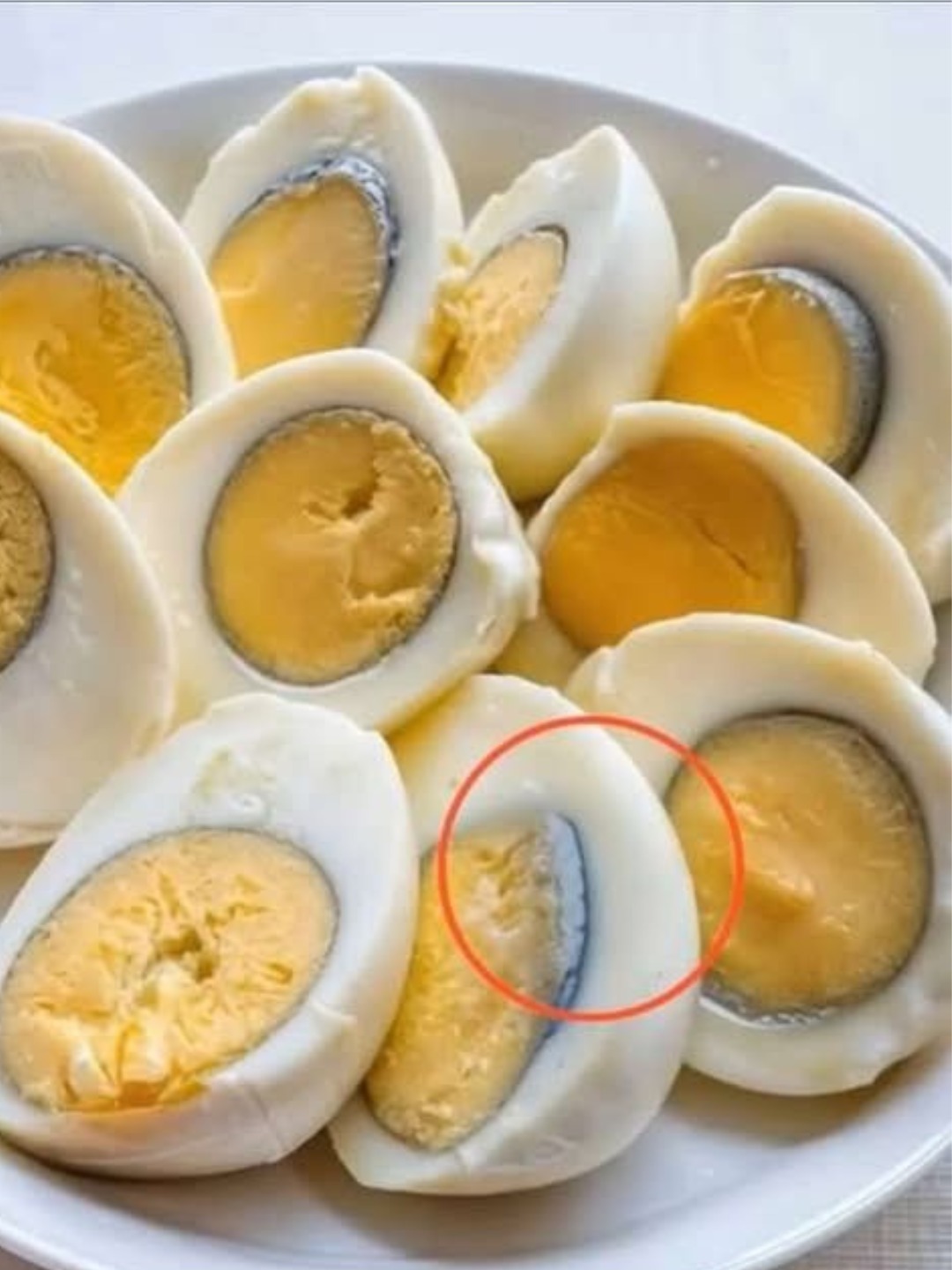
You crack open a hard-boiled egg with pride — perfectly cooked, you think.
But then… you see it.
A greenish-gray ring hugging the yolk like a sad halo.
It’s not mold.
It’s not spoiled.
It’s not dangerous.
But it is disappointing.
And if you’ve ever wondered, “What did I do wrong?” — you’re not alone.
The truth is:
That green ring isn’t a sign of bad eggs or bad cooking.
It’s just science doing its thing.
Let’s break down why it happens, whether it’s safe, and — most importantly — how to avoid it with a few simple, no-fail steps.
🔬 The Science Behind the Green Ring:
That unappetizing ring is the result of a natural chemical reaction — one that’s completely harmless, but easy to prevent.
Here’s What Happens:
The yolk contains iron
The egg white contains sulfur
When eggs are overcooked, heat causes the sulfur in the white to form hydrogen sulfide gas
This gas migrates toward the yolk, where it reacts with iron to form ferrous sulfide — a compound that’s green-gray in color
✅ The longer the egg cooks, the more hydrogen sulfide is produced — and the more pronounced the ring becomes.
And yes — that rotten-egg smell? That’s the sulfur too.
✅ Is It Safe to Eat?
Yes.
The green ring is not toxic.
It doesn’t mean the egg is old or spoiled.
It’s just a cosmetic flaw — like a bruise on an apple.
But while it’s safe, it can signal:
Overcooking
Dry, chalky yolks
Less-than-ideal texture
And if you’re making deviled eggs or egg salad, appearance matters.
So let’s fix it.
🥣 The Foolproof Method for Perfect Hard-Boiled Eggs (No Green Ring!)
Forget guesswork.
