
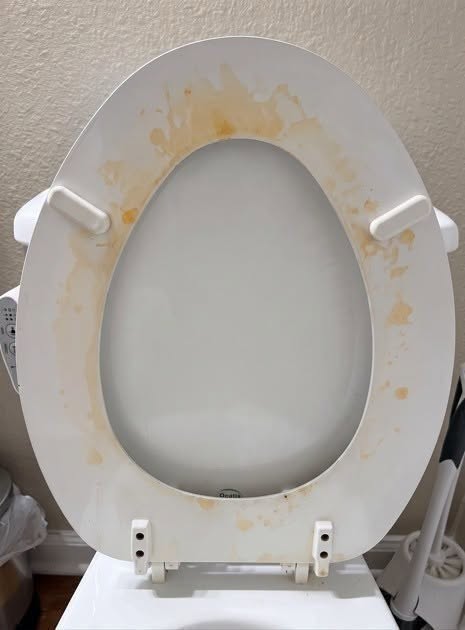
ring becomes obvious.
A quick weekly cleaning can prevent deposits from becoming thick and stubborn.
Don’t Let Mineral Deposits Build Up
If you notice a faint yellow or orange line beginning to form, deal with it early.
A light deposit is much easier to remove than years of buildup.
Keep the Bowl Clean and Dry When Appropriate
Regular flushing and cleaning can help prevent residue from accumulating.
If the toilet isn’t used frequently, occasional cleaning can still help keep mineral deposits under control.
Consider Your Water Quality
If multiple fixtures in your home develop white, yellow, orange, or brown mineral buildup, hard water or dissolved metals may be contributing to the problem.
You may notice similar deposits around faucets, showerheads, sinks, and tubs.
In that case, cleaning the toilet repeatedly treats the symptom, not the source.
If the ring keeps returning despite regular cleaning, it may be time to look
beyond the stain itself.
When the Stain Keeps Coming Back
If you’ve cleaned the toilet thoroughly and the yellow ring returns surprisingly quickly, there may be an underlying issue.
Hard water is one possibility.
Another is a toilet that doesn’t flush or refill properly, leaving water sitting at a particular level.
A slow leak can also contribute to persistent staining because water continually passes over the same area.
If the staining seems unusually persistent, it may be worth checking the toilet’s plumbing and water supply rather than simply reaching for more cleaner.
Is the Yellow Ring Dangerous?
Usually, a yellow or brown toilet ring is more of a cleaning and appearance problem than a sign that your toilet is somehow contaminated beyond normal household cleaning.
The exact cause matters, though.
Mineral deposits, rust, and residue can all produce similar-looking stains.
If the toilet is cleaned regularly and there are no
plumbing problems, the ring is generally something you can address as a normal household cleaning issue.
Frequently Asked Questions
Can I use a pumice stone on a toilet?
A pumice stone can be useful for stubborn mineral buildup on appropriate porcelain toilets, especially when lighter cleaning methods have not worked.
However, it is abrasive. Keep both the stone and the porcelain wet, use light pressure, and follow the toilet manufacturer’s recommendations before using it.
Why does my toilet keep getting a yellow ring?
Hard water, mineral deposits, iron in the water, and residue can all contribute.
If the ring returns quickly, investigate whether your water quality or toilet plumbing is contributing to the problem.
Can bleach remove hard-water stains?
Bleach may help with some organic staining and disinfecting tasks, but it isn’t necessarily effective against mineral deposits.
A product designed to remove limescale or mineral buildup may be more appropriate.
Can I mix vinegar and bleach to clean my toilet?
No.
Never mix bleach with vinegar or other acidic cleaners. Dangerous chlorine gas can be released.
How often should I clean my toilet?
A regular weekly cleaning is a good starting point for many households, with more frequent cleaning if the bathroom gets heavy use.
What if the stain won’t come off?
If a product specifically designed for toilet cleaning can be used safely on your toilet’s surface, follow the manufacturer’s directions.
For appropriate porcelain toilets, a wet toilet-cleaning pumice stone can sometimes help with stubborn mineral deposits. Keep both the stone and porcelain wet, use light pressure, and check the manufacturer’s recommendations first.
If gentle cleaning and an appropriate descaling method don’t work, avoid escalating to increasingly abrasive tools.
The porcelain finish can be damaged.
At that point, consider a professional cleaning product recommended for the toilet’s specific surface
or consult the manufacturer.
Will vinegar remove a yellow toilet ring?
Vinegar can help dissolve some mineral deposits because of its acidity. Its effectiveness depends on the type and thickness of the buildup.
For a thick or established ring, gentle cleaning combined with an appropriate descaling method may be more effective than vinegar alone.
The Bottom Line
That ugly yellow toilet ring can make you feel like you’ve been cleaning for absolutely nothing.
But once you figure out that you’re dealing with mineral buildup rather than ordinary dirt, the solution becomes much clearer.
For stubborn deposits on suitable porcelain, a wet toilet-cleaning pumice stone used gently can make a dramatic difference.
For lighter buildup, vinegar, citric-acid-based descalers, or a commercial limescale remover may help.
And please remember the most important rule of all:
Never mix cleaning chemicals.
A little patience, the right method, and some regular maintenance can keep that
gross yellow ring from taking over your toilet again.
And honestly, there’s nothing quite like lifting the toilet lid and seeing a clean, bright bowl staring back at you.
That little cleaning victory?
“`
