
Changes rapidly over a short period
Becomes very dark or develops markedly uneven coloring
Bleeds without
being bumped or irritated
Becomes significantly painful
Is associated with a larger lump underneath the skin
Is accompanied by many new or unusual lesions appearing over a short period
It is also sensible to seek professional advice if the growth is close to the eye, inside the nostril, or along the lip border, because these locations can be more difficult to treat safely.
If your daughter has a condition or medication that affects her immune system, or has a history of unusual skin growths, a clinician should also evaluate the lesion rather than relying on home treatment.
- How Contagious Is It in Everyday Life?
Warts can spread, but simply being in the same room as someone with a wart is not generally the main concern. Transmission is more associated with direct contact, picking at the lesion, shaving over it, or sharing personal items that come into close
contact with the
affected area.
For the next few weeks, it is sensible for her not to fiddle with the growth or shave directly over it. Avoid sharing razors, washcloths, makeup tools, or other personal items that could come into contact with the lesion.
Washing hands after touching the area is another simple precaution that can reduce the chance of transferring the virus to another part of the body or to another person.
- Why Teenagers Often Find This Especially Upsetting
At that age, a tiny bump can feel much more noticeable than it actually is. Photo days, public performances, mirrors, phone cameras, and self-consciousness can make a small skin issue seem enormous.
Along with practical skin care, reassurance can help. An audience at a recital is likely to focus on the performance itself rather than a tiny neck bump.
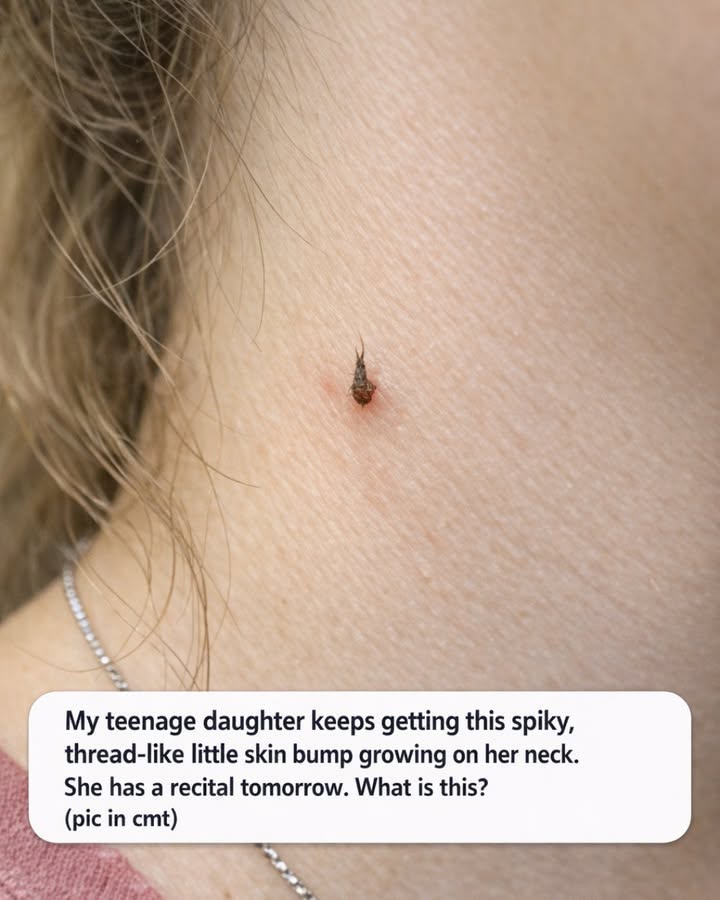
If the growth turns out to be a filiform wart,
it is generally treatable
and is not a reflection of poor health or cleanliness.
- A Sensible Plan for the Next 24 to 72 Hours
For tonight, cleanse the area gently, leave it alone, avoid harsh treatments, and keep hair, collars, jewelry, and costume materials from snagging or rubbing against it.
For tomorrow, use minimal makeup if needed, avoid picking at the lesion, and let her focus on the recital.
Afterward, if the growth still appears spiky and thread-like, schedule a routine appointment with her primary care clinician or a dermatologist. A professional can determine whether it is actually a filiform wart or another type of skin growth and discuss appropriate treatment if necessary.
If possible, take one clear photograph tonight in good natural light from a reasonable distance, then another in a few days. Keeping dated photographs can make it easier to notice whether the lesion is stable or
changing.
- The Bottom Line
Based
- on the description—a teenage girl with a small, spiky, thread-like bump on the neck—a filiform wart is one possible explanation. However, a photograph or in-person examination is needed to determine what the growth actually is.
For the night before a recital, the gentlest approach is usually best: leave the lesion alone, avoid cutting or aggressive wart-removal products, protect it from friction, and use minimal makeup if needed.
If the growth remains small and otherwise unchanged, a doctor or dermatologist can confirm the diagnosis and discuss removal options after the recital. If it becomes painful, changes rapidly, bleeds spontaneously, develops unusual coloring, or otherwise looks concerning, arrange an evaluation sooner.
For tonight, keep the focus on the recital and avoid turning a small skin bump into an irritated wound with a last-minute treatment.
“`
